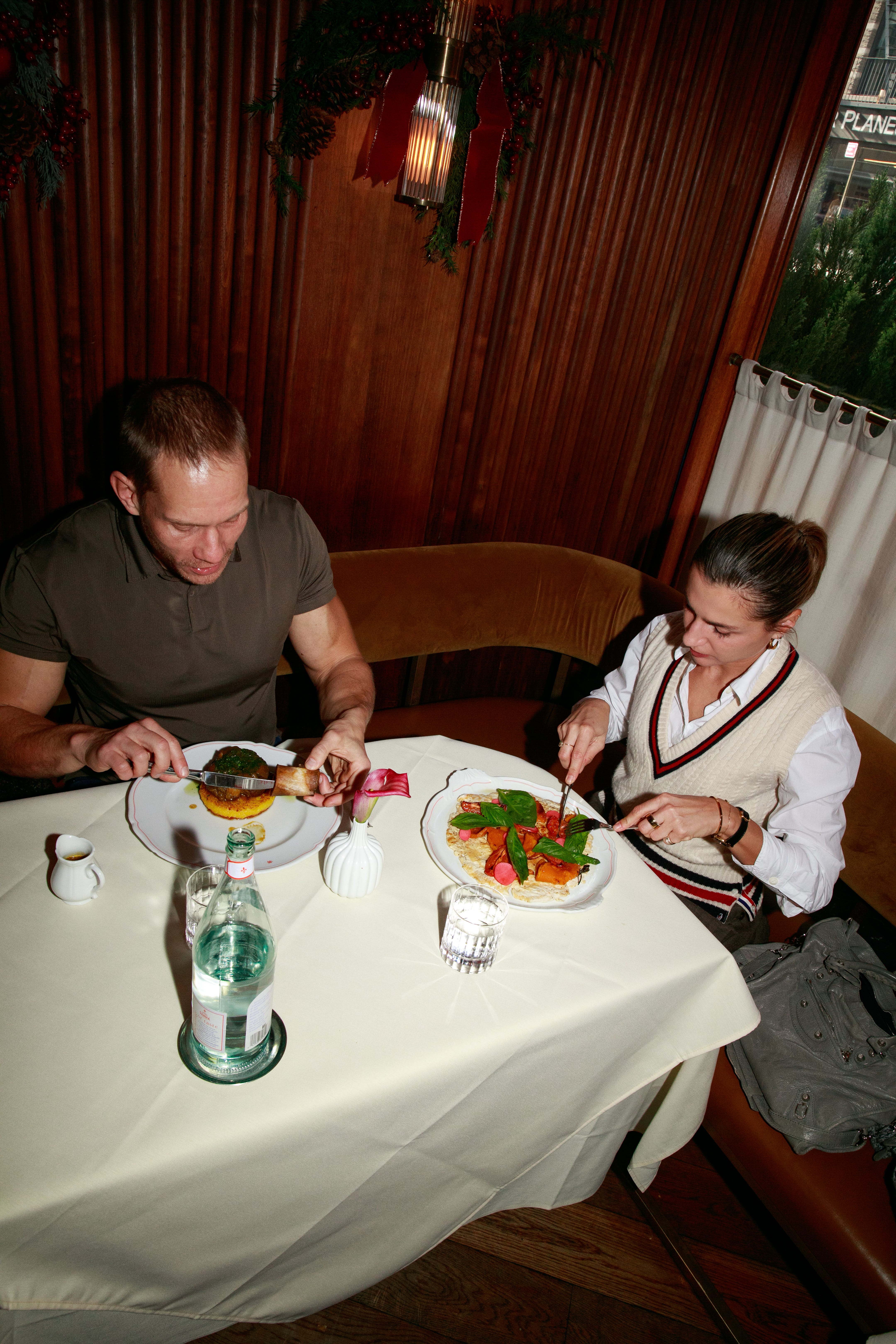
I had lunch with Tommy Wood, BM BCh (MD), PhD last week, a leading neuroscientist who trains F1 drivers. We ate at the place (Sant Ambroeus Soho) that puts my mind most at ease in NYC, where I’ve cried, laughed and had more than few Bellinis. If there’s one place in NYC I consider my home turf, this is it and on a frigid day in early December I felt warm, educated and alive with Dr. Tommy!
The TLDR I hope you makes read this entire thing: you’re probably making yourself sicker by trying too hard to be healthy.

Tommy (probably) explaining to me the below traffic light system metaphor for busy humans
The Traffic Light System for Busy Humans
Tommy introduced me to this brilliantly simple framework for managing health when life gets chaotic. Think of it like traffic lights:
Green: Everything’s cruising. You’re hitting the gym, meal prepping, meditating, sleeping eight hours. This is your baseline.
Yellow: Things are busy but manageable. Drop the meditation, simplify your workouts to quick home sessions, but keep the fundamentals. Pick what matters most and let the rest go - without the guilt.
Red: Total chaos mode. Deadlines, travel, family emergencies. You get one anchor. Maybe it’s just protecting your sleep. Maybe it’s a 10-minute workout because you know it helps your brain function. That’s it.
The insight: worrying about all the things you’re not doing creates more stress than just accepting reality and doing one thing well.
Metabolic Flexibility: What It Actually Feels Like
Forget the complex science for a second. Here’s the test: Can you eat a big bowl of pasta without feeling like you need a nap? Can you skip breakfast without spiraling into hangry chaos?
That’s metabolic flexibility. Your body can handle carbs. It can handle not eating for a bit. If you can’t do these things without feeling terrible, that’s your signal.
The Perception Problem (or Opportunity?)
This is where things got interesting. Tommy said something that’s been rattling around in my head:
“How you feel after an intervention matters more than what the data says.”
I take magnesium for sleep. Maybe it’s placebo. Maybe it’s real. But if I wake up feeling rested and believe the magnesium helped, does it matter? The perception of recovery might be as powerful as the recovery itself.
He cited studies on creativity and cannabis - people feel more creative when high, but objective tests show they’re either the same or worse. The subjective experience doesn’t match reality.
But here’s the twist: for sleep, for stress, for daily functioning, your subjective experience is your reality.

The best chicken paillard - not much fiber but I definitely got my protein portion!
The Workout Hierarchy (for longevity)
Stop overthinking your exercise routine. Tommy laid out a dead-simple hierarchy:
Stand up more. Break up sitting. Walk. Take stairs. This improves blood pressure and brain function without breaking a sweat. Unplanned movement is understated key to health.
Move 20-30 minutes daily. Just walk. That’s it. Not everything needs to be optimized.
Lift weights 1-2x per week. Hit every muscle group. Three sets of 8-12 reps. Nothing fancy. This is for your brain as much as your body.
Add sprints if you have time. Short bursts of hard effort. Not mandatory, just beneficial.
Bonus points for coordination. Pickelball, dancing, soccer, anything with complex movement and social interaction seems to be magic for brain health. You’re getting exercise, coordination, and social connection in one shot (I see you Padel!)

The Alcohol Question Everyone Asks
“How bad is drinking really?”
Tommy’s take: the recent studies (promoted by the likes of Attia) claiming “no safe amount” are based on Mendelian randomization, which he calls “not real science” for this purpose. The actual data? One drink per day on average shows basically no net effect. Cardiovascular risk goes down slightly, cancer risk up slightly, dementia risk is a wash.
He drinks maybe once every couple weeks, something he enjoys, with people he enjoys. No supplements, no mitigation strategies, no guilt.

The Brian Johnson Effect
So are we (those obsessing over longevity) going to actually live longer?
No one knows… but, Tommy has been wondering whether all this tracking does more harm than good - not because of the protocols themselves, but because of the psychological stress of believing aging is so terrible while inevitably aging anyway.
Studies show people with positive perceptions of aging live significantly longer than those who view it as decline. If you’re constantly stressed about getting older, you’re creating the exact conditions that accelerate aging.
What I’m Taking Away
I’ve spent years in the longevity world, and honestly, sometimes I feel that the closer I get to it, the worse my health anxiety becomes. I know too much. I read too much. I stress about what I do and do not do to optimize everything.
Tommy’s message: metabolic flexibility isn’t just about your body adapting to different fuels. It’s about psychological flexibility - adapting to imperfect circumstances without creating fragility through rigidity.
The science matters. The data matters. But your lived experience matters more. If you feel good, perform well, and aren’t constantly stressed about your health metrics, you’re probably doing fine.
Maybe the real optimization is learning when to stop optimizing.