


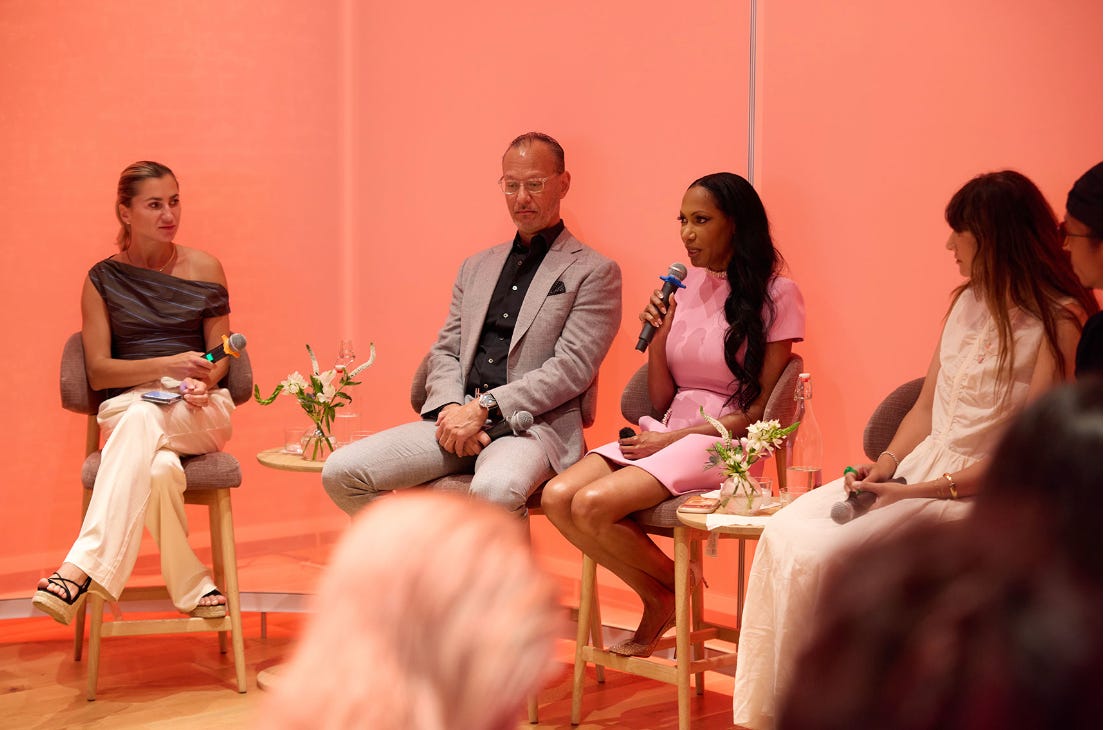
Dr Joseph Raffaele, Dr Judith Joseph, Amil Niazi, Joshua Halland, moderated by me
On June 30, 113 Spring in NYC, became something it wasn’t before. The space - already a site for longevity practitioners, experimental wellness, and people asking better questions about how to actually live well - shifted its entire theme and architecture around a single word: ENERGY. Not the fitness kind. Not the Instagram kind.
Energy as the thing that moves between us, not just within us. Energy as the actual substrate of how we live, not another metric to game.
Almost 100 people in an intimate room in SoHo, many of them the type who’ve already read the papers, already tried the protocols, already know what a CGM is and why you probably don’t need one if you’re healthy. They showed up because something in the cultural moment has shifted. The optimization era has an expiration date, and people feel it before they can name it.
What happened that morning - across five panels, three workshops, and a series of hands-on experiences - was a very specific kind of reckoning. Not a rejection of optimization. Not a “do nothing” pivot. Rather, a hard look at what happens when the pursuit of health becomes the very thing that depletes you.
The Whole Thing: Why It Matters
The wellness industry, by design, sells fragmentation. More data, more biomarkers, more testing, more things to optimize. It’s a business model that works because it answers the anxiety question - ”What if I’m missing something?” - with a product: a wearable, a blood test, a supplement stack, a protocol. This industry has been my entire career. I’ve seen it from the inside at Equinox. I’ve analyzed many longevity companies, research papers or founders claiming they’ve cracked the code.
What I’ve watched is an ecosystem optimizing for complexity, not clarity.
113 Spring’s theme shift signals something different. The frame moves from “How do I optimize?” to “What actually moves through me?” That’s not semantic.
It’s a fundamental question about whether longevity is something you do alone or something you inhabit in relationship - to your body, to others, to time itself.
The Workshop That Made It Concrete
You could see the shift most clearly in the afternoon workshop: the Traditional Chinese Medicine (TCM) Herbal Masterclass with Zoey Xinyi Gong. They brought the whole herbs experience to New York - not powders, not abstractions, but the actual plants you crush with a mortar and pestle. The sensory experience is deliberate. You smell them. You feel the texture. You watch them transform under your hands.
One of the panelists later remarked on what Zoey had talked about: the modern wellness space wanted to abstract everything into clean forms. More efficient. Cleaner. But there’s something we lose when we optimize away the friction.
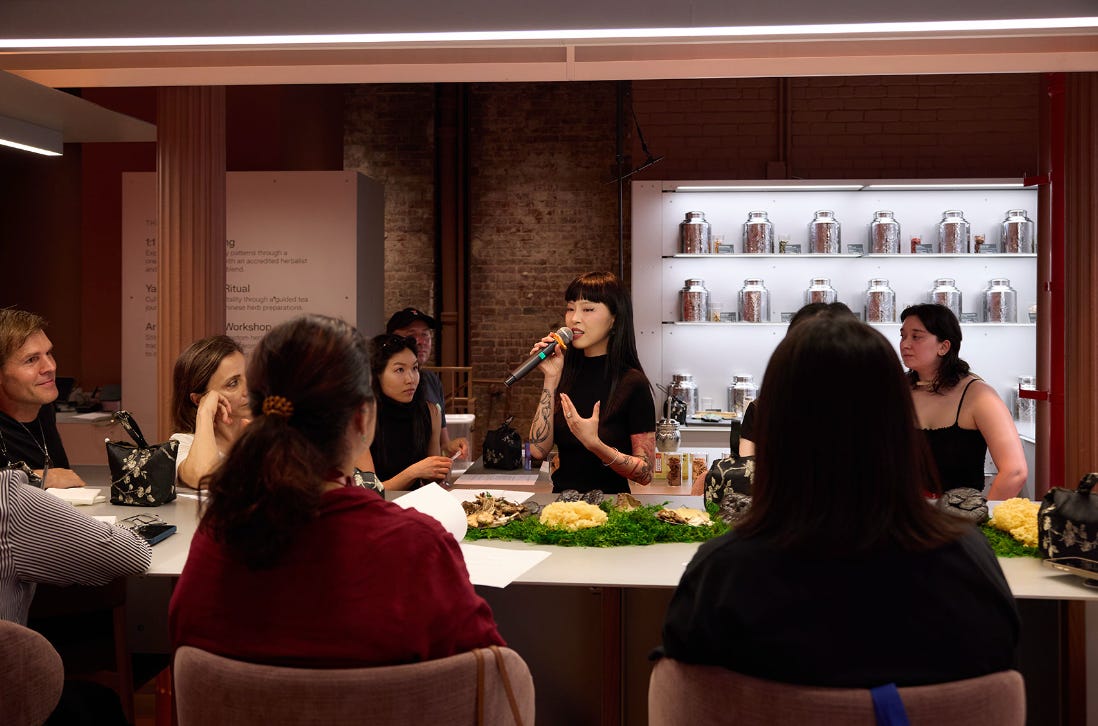
TMC workshop with Zoey Xinyi Gong
When you grind an herb yourself versus swallowing a capsule, you’re not just taking medicine - you’re making a conscious choice about how you want to relate to your own care. That human-scale friction is data too. Different data. The kind your nervous system understands before your brain does.
This matters because it points at the actual problem we spent examining in Panel #2: the optimization paradox.
The Paradox: What We Talked About
I had the pleasure to moderate this panel and here’s what I learned:
After almost 3 decades in longevity medicine Dr Joseph Raffaele tells you: don’t measure something unless it’s going to change your management.
That axiom is load-bearing. And what he sees in NYC is a culture that violates it constantly. People measure their sleep with Oura rings. They measure their glucose with continuous monitors they don’t medically need. They measure their heart rate variability, their mitochondrial function, their genetic predisposition to things they can’t control. And the data changes nothing. They wake up, read the number, feel worse about themselves, and keep going.
The people most optimized for health often suffer from diminished mental health. Dr. Judith Joseph, a psychiatrist who studies something called high-functioning depression and anhedonia, put it plainly: we’re hunting disease so hard we’ve forgotten to measure joy. And joy, according to the longest longitudinal health study in human history (Harvard’s Grant Study, running since the 1930s), is the actual #1 predictor of longevity. Not your biomarkers. Not your protocol. The quality of your relationships and your capacity to feel joy.
What’s interesting is what gets missed in that data-optimization cycle. Joshua Holland, who coaches some of the highest-performing people in the world, said it directly: burnout doesn’t arrive because people aren’t trying hard enough. It arrives because they’re trying hard at the wrong things, and they can’t see the difference anymore. The awareness is gone. The distinction between “training hard” and “breaking down” collapses when you’re in it.
Amil Niazi, who literally wrote the book on stepping back from that treadmill (Life After Ambition), described it differently: burnout is the natural endpoint of constant optimization. You’re told you could be younger, hotter, fitter, more optimized if you just try harder, measure more, optimize better. The dream is at your fingertips. Except it’s not—it’s out of reach for most people, because it costs time or money or both. The result is a permanent anxiety loop. You know what you could be. You’re just not it.
The Question Nobody Asks Until It’s Too Late
The harder question emerged in the panelists’ lived experiences. Dr. Judith talked about patients who come to her not naming optimization as the problem - it shows up as insomnia, or anxiety, or relationship friction. You have to ask the right question to find the optimization underneath.
Dr. Raffaele described it as a concept called hormesis - the biological principle that stress is good because your body adapts to it. But there’s a threshold. Too much stress and your body breaks down instead of adapting. And there’s a grace period most of us skip: you’re allowed to not be optimized. You’re allowed to watch TV. You’re allowed to do nothing for a few hours and call that a legitimate recharge instead of a failure of discipline.
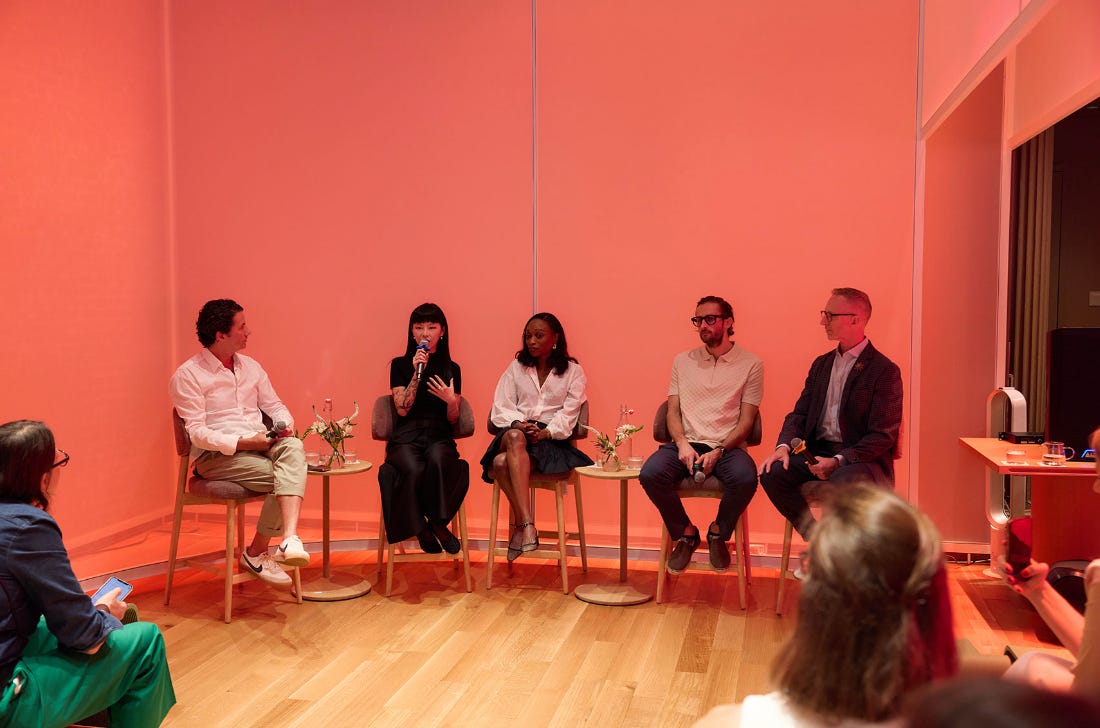
Romain Gaillard (Founder Detox Market), Dr Stephanie Kuku, Dr. Paul Schmidt-Hellinger and Brian Le Gette
What Changed in the Room
By the end of the morning, something subtle had shifted in the air. It wasn’t that anyone renounced optimization. Joshua still coaches elite athletes. Dr. Raffaele still measures biomarkers when they matter. Amil still works. But there was space opened for a different question: What are we optimizing for?
If the answer is “to feel good later,” then you have to ask whether your optimization is actually getting you there or whether it’s become a substitute for feeling good now. If the answer is “to have more time with people I love,” then you have to measure whether your protocol is eating that time. If the answer is “to have impact,” then you have to be honest about whether your optimization is draining the very energy you need to make an impact.
The Grant Study didn’t find that optimized people were happier. It found that people with strong relationships were happier. And they were healthier. And they lived longer. That’s the data people don’t want to measure because it’s not quantifiable. You can’t A/B test a conversation. You can’t optimize a sunset. You can’t protocol your way into belonging.
113 Spring’s shift - from treating energy as a problem to solve to treating it as something shaped between us - is a small move. But it’s the right one. The whole herbs matter. The shared space matters. The conversation matters. And the next time someone tells you about their latest optimization protocol, the question isn’t whether it works. The question is whether it’s making you feel more alive or less.
If this gave you something to think about, pass it on. Restack it for someone who’s optimizing themselves into a corner. Reply and tell me where you land, or subscribe if you’re new here. I read everything.
In Search Of is where I chase the questions the wellness industry is too sure about.
Scientific Appendix
Harvard Study of Adult Development (Grant Study) Waldinger, R. J., & Schulz, M. S. (2016). The long reach of childhood trauma: a longitudinal study of intergenerational patterns of social functioning. Journal of the American Academy of Child & Adolescent Psychiatry, 45(12), 1437-1449. [Followed Harvard undergraduates and their descendants for 88+ years; relationships identified as #1 predictor of longevity and health]
High-Functioning Depression You may want to verify the exact citation on this—it was referenced in the panel but I want to flag that this specific terminology and its peer-reviewed literature is less established than classic major depressive disorder. Worth checking Dr. Joseph’s recent publications directly.
Anhedonia in Longevity Research Snaith, R. P. (1993). Anhedonia: a neglected symptom of psychopathology. Psychological Medicine, 23(4), 957-966.
Hormesis and Stress Adaptation Calabrese, E. J., & Baldwin, L. A. (2003). Hormesis: the dose makes the poison. Current Opinion in Toxicology, 7(3), 91-97.
Wellness Burnout and Orthorexia-Adjacent Behaviors You may want to verify this—orthosomnia (obsession with biometric optimization) is real but emerging in literature. The nexus between optimization culture and psychiatric distress is clinically observed but still consolidating in peer-reviewed space. I’d recommend checking recent publications from practitioners like Dr. Joseph and Dr. Raffaele directly rather than relying solely on older literature.
If this gave you something to think about, pass it on. Restack it for someone who’s optimizing themselves into a corner. Reply and tell me where you land, or subscribe if you’re new here. I read everything.
In Search Of is where I chase the questions the wellness industry is too sure about.