


A few years ago, I started adding up how much I spent on my health.
Not healthcare. Health.
There is apparently a difference.
Gym. Trainer. Supplements. Acupuncture. Sauna. Recovery. Wearables. Tests. Treatments. Things I had been convinced would fix my gut. Things I had been convinced would make me live longer. Things I had been convinced would make me look better while living longer.
The number was so high I assumed I had calculated it wrong.
So I kept looking.
Then it got worse.
A trainer can easily run $15,000+ a year. Add a great gym membership, acupuncture, massages, supplements, wearables, recovery, testing and suddenly a very normal-looking wellness routine becomes a $25,000–$50,000 annual portfolio before you’ve done anything particularly insane.
And I have done some insane things.
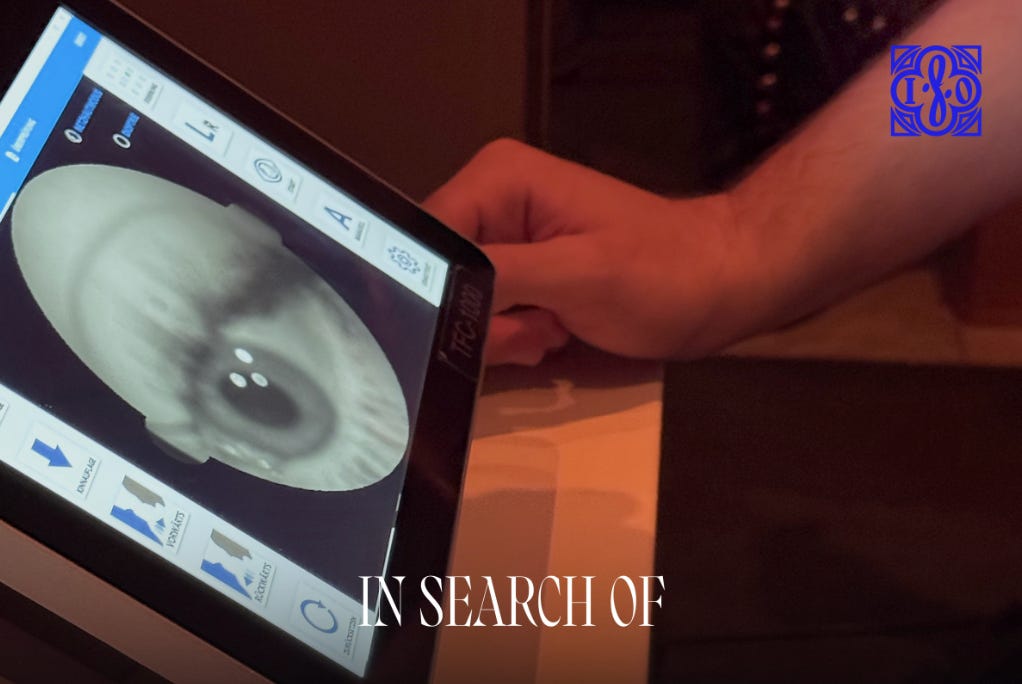
My actual eyeball, at some eye test, at Superhuman conference in Stockholm last year
I’ve spent around $1,500 on a single intervention intended to affect my stress response (and that was a deeply discounted price given to me by a friend). Bodywork can run me $500 a session. A week at one of the medical-wellness retreats I find myself looking at can move from a few thousand dollars to $30,000 surprisingly quickly.
This is also a conservative exercise for me. I’ve spent most of my career working in wellness and longevity, so I’ve been lucky enough to receive gym access, treatments and experiments for free.
Paying retail for my curiosity would be considerably worse.
It was particularly embarrassing because before wellness, I worked in finance.
I know how a portfolio is supposed to work.
You establish your objective. Understand your time horizon. Assess your tolerance for risk. Protect the downside. Allocate most of your capital accordingly.
Then you leave it alone.
You do not wake up Tuesday, discover a new asset class on a podcast and rebalance the entire thing before lunch.
Unless, apparently, the asset is your body.
My personal health portfolio feels like seed-stage VC
I’ve done things before most like injecting donated human tissue into my arm.
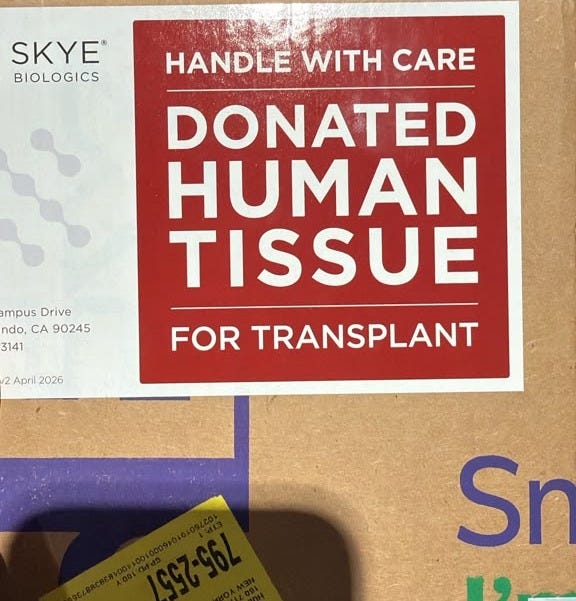
Actual image from Jonathan Kuo from Extension Health who injected this to help my tennis elbow. It did work.
It fixed a problem I’d spent six months trying to fix with physical therapy, so despite how that sentence sounds, I would do it again.
I’ve had an ultrasound-guided injection intended to affect my stress response. Roughly $1,500 for one intervention.
Also: would do again.
Currently, I want to try plasmapheresis.
The simplified pitch is essentially filtering and replacing components of your plasma. It’s an established medical procedure for certain diseases. Using it as a general longevity or post-viral intervention is a very different proposition, and one for which I don’t have evidence that it will solve my problems.
I still want to do it.
Some part of me remains convinced that some of my unresolved health issues could trace back to long COVID, and there is something incredibly seductive about the idea of physically cleaning something unwanted out of my body.
This is not how I was taught to underwrite investments.
But this is exactly the point.
When the asset is our own body, even people who understand risk and return become remarkably bad investors.
Hope changes the calculation.
If you have a problem nobody has been able to solve, a speculative intervention doesn’t feel speculative.
It feels like possibility.
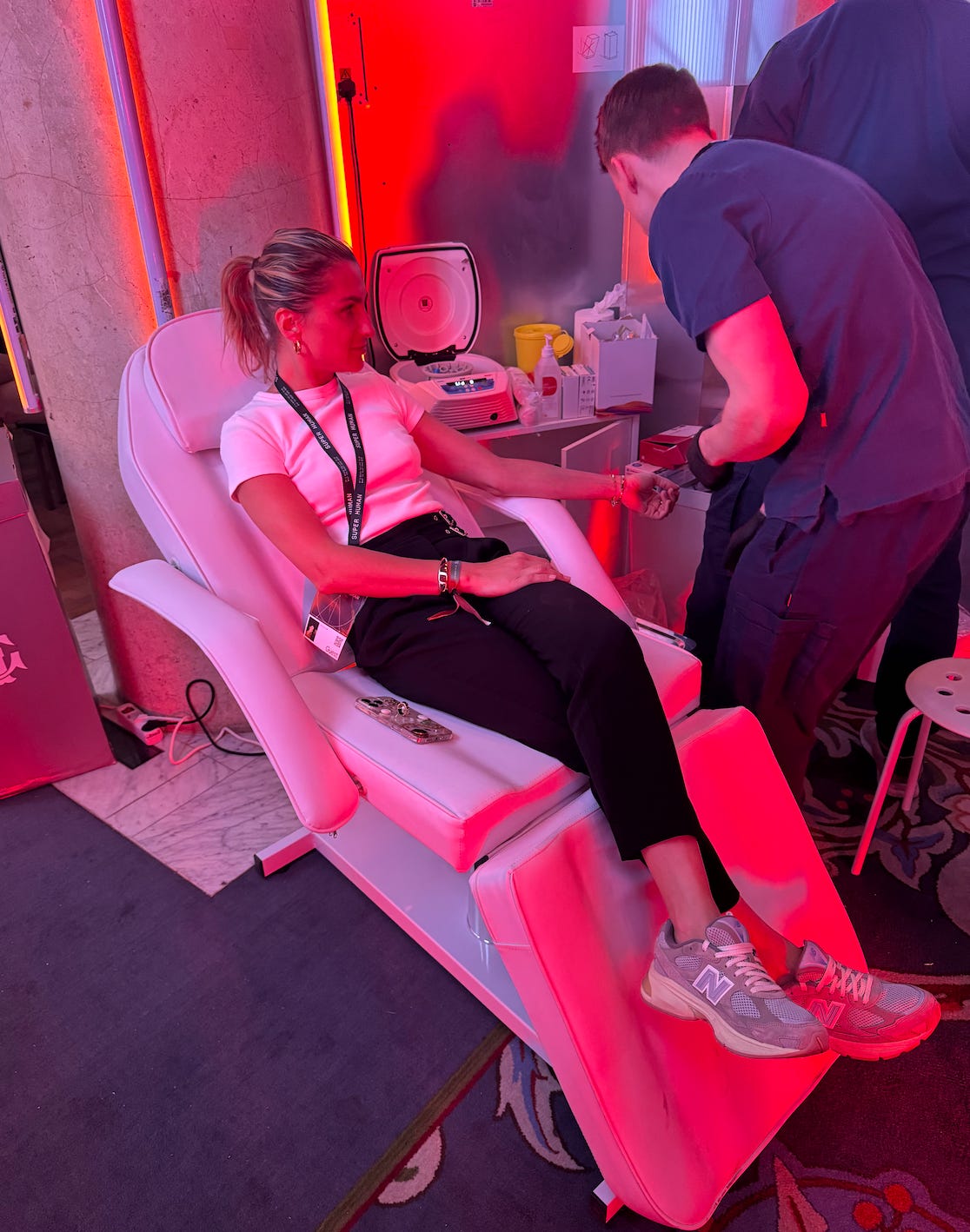
I’m known to just try things, sometimes to my own detriment - here i am at the Superhuman conference in Stockholm last year having some of my blood plasma taken.
I tried doing it the responsible way too.
Once, I had an actual health issue and went to One Medical.
I rearranged my workday and skipped a meeting to go.
They checked my pulse, ran basic bloodwork and told me that if I still felt the same in a week, I should come back.
I was very much not okay.
“Wait and see” may have been medically reasonable. But after the friction of getting the appointment, rearranging my day and showing up, leaving with no understanding of what to do next was incredibly frustrating.
So I did something equally ridiculous.
I went home, opened ChatGPT and essentially figured out my own medication plan.
It helped.
I am aware this is not the lesson anyone should take from this story.
The lesson, for me, was how completely I’d become accustomed to self-managing my health.
And there’s an important distinction here.
I know what I’d spend on preventative health.
I already do.
Equinox and my trainer aren’t frivolous “wellness” expenses in my portfolio. They’re prevention. Training consistently is one of my core holdings. So are sleep and the things that keep my body moving well enough that I can continue training.
The gap is healthcare.
When the next real issue emerges, who knows my history? Who looks at my three-year trends rather than today’s bloodwork? Who decides whether I need a gastroenterologist, endocrinologist, another test, medication - or nothing at all?
I don’t have that system.
I’ve never had a relationship with a doctor long enough for someone to look at my life that way. My data is between Poland, Spain, UK and many states of US.
My Oura has known me longer than any physician has.
And while I’m skeptical that obsessing over whether my HRV moved this week is particularly useful, years of measurement allowed me to see a multi-year downward trend.
Whether the hypotheses I’m developing about why prove correct is another question.
But nobody else was watching long enough to ask it.
So I became the person watching.
With Dr Hyman at that same conference.
I accidentally became my own health CIO
CIO = Chief Investment Officer.
This is where the finance analogy stopped being funny to me.
If I were managing a financial portfolio the way I manage my health, I would fire myself.
I trade constantly.
New symptom. New test. New supplement. New expert. New protocol. New study. New theory.
Rebalance.
And the more I thought about it, the more obvious the comparison became:
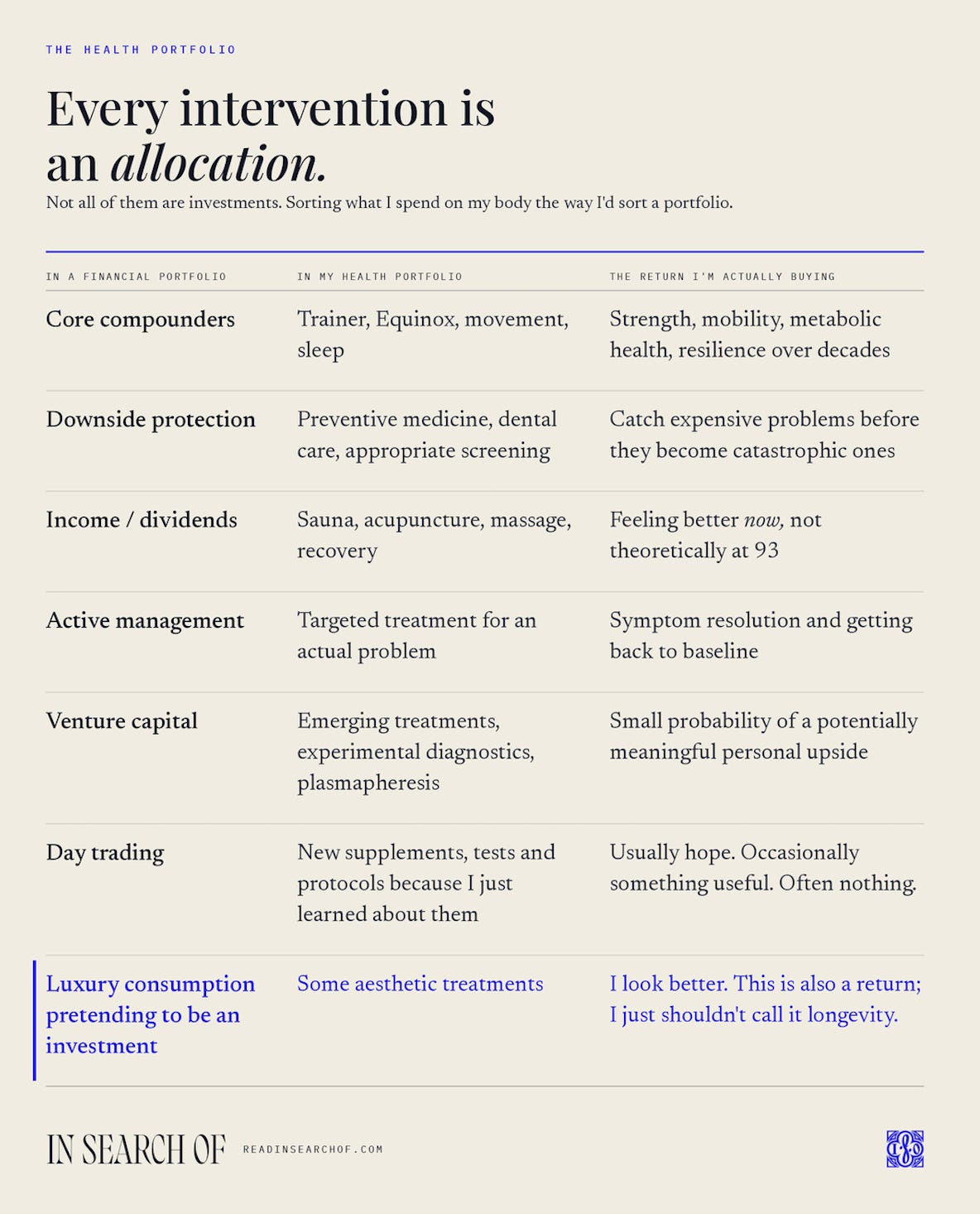
Some aesthetic treatmentsI look better. This is also a return; I just shouldn’t call it longevity.
The last row may be the most financially honest thing I’ve ever written about wellness.
Because one of the problems with longevity is that we’ve started forcing almost anything that makes us feel good under the umbrella of “health.”
Sometimes a laser is a health investment.
Sometimes I just want good skin.
Both are allowed.
The important thing is knowing which one I’m buying.
Wellness solved a problem healthcare didn’t
Wellness figured out how to make taking care of yourself desirable.
Healthcare largely didn’t.
Movement, recovery, sauna, acupuncture, beautiful gyms, increasingly sophisticated diagnostics: the best parts of wellness took things people knew they “should” do and made them things people actually wanted to do.
That matters.
My trainer and gym membership are probably among the highest-return investments in my portfolio. Training consistently changed my strength and mobility and, perhaps more importantly for someone constantly traveling, gave my body some rhythm.
And unlike some of my more exotic experiments, physical activity has an enormous evidence base behind it.
Sauna is different: I love it and feel better afterward, while the evidence for long-term health outcomes is interesting but substantially less definitive than the evidence for exercise.
But here’s something longevity conversations sometimes miss:
I don’t actually need everything I do to make me live longer for it to produce a return.
I pay around $250 for some recovery/bodywork sessions because my body feels meaningfully different afterward.
I spend a lot of time on planes. I work out. I get tight.
If something reliably makes Tuesday better, that’s a return too.
Feeling good while I’m alive belongs somewhere in the longevity equation.
It cost me a fortune to discover my index funds
After years of access, experiments, practitioners, supplements, tests and treatments, my core portfolio has become surprisingly unsexy.
Trainer.
Gym.
Sauna.
Acupuncture.
Recovery.
Sleep.
A small number of supplements that have produced enough of a noticeable or measurable difference for me to keep taking them.
It cost me a lot of money to narrow the list down this far.
That’s the part I find absurd.
The consumer isn’t presented with a portfolio of interventions ranked by evidence, expected return, downside and relevance to their problems.
We’re presented with an endless feed.
Peptide.
Cold plunge.
CGM.
Supplement.
Full-body MRI.
Hyperbaric oxygen.
Plasma exchange.
Another supplement.
Another test to tell you which supplements.
Every one gets its own expert, mechanism and convincing podcast episode.
And the economic incentives aren’t neutral.
Longevity is very good at monetizing novelty.
Exercise consistently for the next 40 years is difficult to turn into a new product every quarter.
Optimization is considerably easier.
So we risk spending enormous amounts chasing marginal upside while missing much larger risks.
Which, in portfolio terms, is insane.
The missing 80/20
I don’t think the solution is to stop spending on wellness.
That would be intellectually dishonest coming from me.
Some of it has meaningfully improved my life.
The better question is:
What has earned the right to stay in the portfolio?
My trainer has.
Sauna has.
Acupuncture has.
Recovery has.
And then there should be room for conventional healthcare, not merely as “prevention” - because I already invest heavily in prevention - but as infrastructure.
A system that knows my history and is there when something actually goes wrong.
Then there are bets.
Experimental interventions. Emerging science. Things where the evidence isn’t there yet but the potential upside is interesting enough that, after understanding the downside, I may decide I’m willing to lose the money.
I don’t think that allocation should be zero.
I work in longevity because I believe there is enormous value in emerging science.
I just don’t think venture capital should accidentally become the S&P 500.
And mine sometimes has.
What would I do with another $10,000?
If someone gave me $10,000 tomorrow and said I could only spend it on my health, I know exactly what I’d want to do.
Massages.
Recovery.
Some excellent lasers.
Probably something weird.
I know what I should probably do with at least part of it:
build better healthcare infrastructure around myself.
Not “prevention.” I know how to do prevention.
I mean figuring out who I call when the next real problem happens.
Who knows my history?
Who can look across specialties?
Who can tell me when something actually deserves intervention and when I should genuinely wait a week?
Who stops me from going home and asking an AI to prescribe me something?
Despite spending years working in health and longevity, I don’t have a particularly good answer. And I don’t think I’m the only one.
That might be the most revealing line item in my entire portfolio.
Wellness has made spending $10,000 extraordinarily easy.
Healthcare hasn’t made spending $10,000 intelligently nearly as easy.
And somewhere between the two, we’re left assembling our own portfolios from doctors, podcasts, algorithms, blood tests, friends and whatever someone smart told us about at dinner.
I’m not giving up my trainer.
I’m definitely not giving up the sauna.
I’m not even promising I’m done making questionable speculative investments.
But I am trying to bring one rule back from my former life:
Stop trading so much.
Know your core holdings.
Know what return you’re actually buying.
Build protection before you need it.
Give yourself a defined allocation for experimentation.
And become considerably harder to sell to.
Because after spending an embarrassing amount trying to optimize my health, I suspect the best portfolio isn’t the one with the most sophisticated interventions.
It’s knowing which few actually move the needle for me - and having a system in place for the day something really goes wrong.
If this gave you something to think about, pass it on. Restack it for someone who’d argue with you, reply and tell me where you land, or subscribe if you’re new here. I read everything.
In Search Of is where I chase the questions the wellness industry is too sure about.
This is sounding increasingly like Bryan Johnson.
Once a health problem becomes chronic, uncertain, and identity-threatening, even people who understand evidence, risk, and expected value can start treating plausibility as probability.