


I called a psychic because a friend told me to. Not for the future. For my gut. Literally.
She didn’t read my cards. She told me to read a book: The Vagus Nerve Reset, by Anna Ferguson. I hung up mildly annoyed, and opened Substack forty minutes later to find vagus nerve content wall to wall.
Then I got on a call with a gastroenterologist I’d met through this newsletter (👋🏼 Dr Mike Hunter) and within ten minutes he was telling me it’s the thing he thinks about most.
Then, the day after this whole thing started, Nick Norwitz MD PhD, someone I follow and genuinely respect, posted an entire series on healing the gut through the vagus nerve and stress pathways.
And by dinner every vagus nerve device company on the internet had found me.
Call it fate, call it my search history. I don’t care which.
Message received.
Medicine failed me first. So I went to the woo. Energy therapy. Hypnotherapy. A psychic. And somehow the woo eventually pointed me back toward medicine.
Thanks to a psychic.
The irony does not escape me.

Last night’s launch dinner for It’s Aioli in LA - Congrats to Twins on launch! JFYI - aioli is superior to mayo as its made with olive oil vs seed oils, so when in doubt, always aioli!
The diagnosis that goes nowhere
Here’s what the psychic and the hypnotherapist had in common, and it wasn’t the incense.
Both told me some version of the same thing: my gut is where I put my emotions.
Stress. Trauma. The usual suspects.
Which is, generously, half an answer and completely useless.
“It’s stress” is a diagnosis with no lever. You can’t do anything with it except feel more guilty about being stressed, which, you’ll notice, does not reduce your stress.
Also: I don’t feel particularly stressed.
I meditate. I do breathwork. I work out. I sleep. I’ve built a life I actually like.
And yet.
The vagus nerve gave me something different. Not a verdict. A mechanism.
Something I could - and I hate myself a little for saying this - actually try to optimize.
I should say, I’ve name-dropped the vagus nerve before. Every self-respecting longevity person has. It’s the industry’s favorite garnish, sprinkled onto podcasts and protocols with a knowing nod.
I did the same.
But I hadn’t actually understood it. Not the mechanism, not the direction the signals run, not really any of it.
Until now.
Three years of trying to find the thing
My gut issues really started after COVID, during a period of my life that, in retrospect, was not exactly calm.
My apartment had been robbed. Life was difficult. I was traveling constantly. I kept working.
I’m not convinced all of that belongs in a medical history. I’m also no longer convinced it doesn’t.
What followed was three years of trying to identify the thing that was wrong with me.
Gut Zoomer from Vibrant (10/10 recommend). Jona (DTC test I recommend). GI-MAP. Genetic testing. SIBO breath tests. Antibiotics. Hormone testing. Function panels. Ultrasounds. Gastroenterology workups. Colonoscopy. Pancreatic enzymes. Allergy testing.
Name a test. I’ve probably had it.
And every time something came back abnormal, I had a new project.
One doctor thought it might be estrogen clearance. Another looked at one result and briefly sent me down a pancreatic rabbit hole. Another found something else.
Each person had one datapoint.
I had all of them.
But weirdly, I was doing exactly the same thing they were.
I was treating my body like a spreadsheet.
Find the red cell. Fix the red cell. Run the spreadsheet again.
At one point I did microbiome testing that gave me an entire new universe of numbers to optimize: too much of this bacteria, too little of that one. Great. More cells.
Then ChatGPT came out.
So naturally I reached the logical endpoint of treating my body like a spreadsheet:
I gave the spreadsheet to AI.
I fed it everything. Tests, symptoms, research, protocols. I used it the way I’d use a doctor or researcher: looking for patterns across information no individual specialist seemed to be holding at once.
Then I researched the research.
Eventually I built an antimicrobial supplement protocol designed to approximate some of the mechanics of another round of antibiotics without actually taking another antibiotic.
And then I took it.
It worked.
That’s the annoying part.
I got better.
But I didn’t get well.
There’s a difference.
I had treated the SIBO. I hadn’t answered why I kept getting SIBO.
And somewhere along the way, what started as trying to heal myself became managing myself.
Berberine. Oregano oil. Neem. Supplements. Food. Another protocol.
Not healing.
Maintenance.

How can nothing be wrong?
Over the last few weeks, I went looking again.
Hard.
For one day I thought my pancreas might not be functioning properly because of one initial result. It was.
I thought maybe I had allergies. I don’t.
Not one.
Which is particularly bizarre because I had allergies as a kid.
Test after test came back okay.
And I found myself in the absurd position of being simultaneously incredibly relieved and incredibly pissed off.
Relieved because I don’t have to eliminate half the foods on earth. Relieved because there doesn’t appear to be some malfunctioning organ everyone missed. Relieved because, by most conventional measures, my body works.
And pissed off because:
How the fuck can nothing be wrong when something is obviously wrong?
I can wake up so bloated I don’t fit comfortably in my pants.
I can wake up with no energy, not wanting to get out of bed.
And maybe the hardest part isn’t even the bloating. It’s the loss of control.
I used to know what to do with my body.
Wake up. Work out. Coffee. Eat normally. Get on with my day.
If something felt off, I knew how to put it back in order.
Now I can wake up feeling terrible and have absolutely no idea why.
And it’s hard to know where the gut ends and the rest begins.
Am I exhausted and miserable because my stomach feels terrible?
Or does my stomach feel terrible because my system was already somewhere else?
I genuinely don’t know.
The chart I stopped looking at
I’ve worn an Oura for years, going back to when I worked on the partnership with Equinox.
So I’ve known about HRV for a long time.
I’ve also watched mine decline.
Something like 30 milliseconds to under 20 over the years, with nights that can drop into single digits (see 7 in there) - which, according to my ring, apparently means I am clinically a corpse.
For someone my age, I’d love to see something closer to 80.
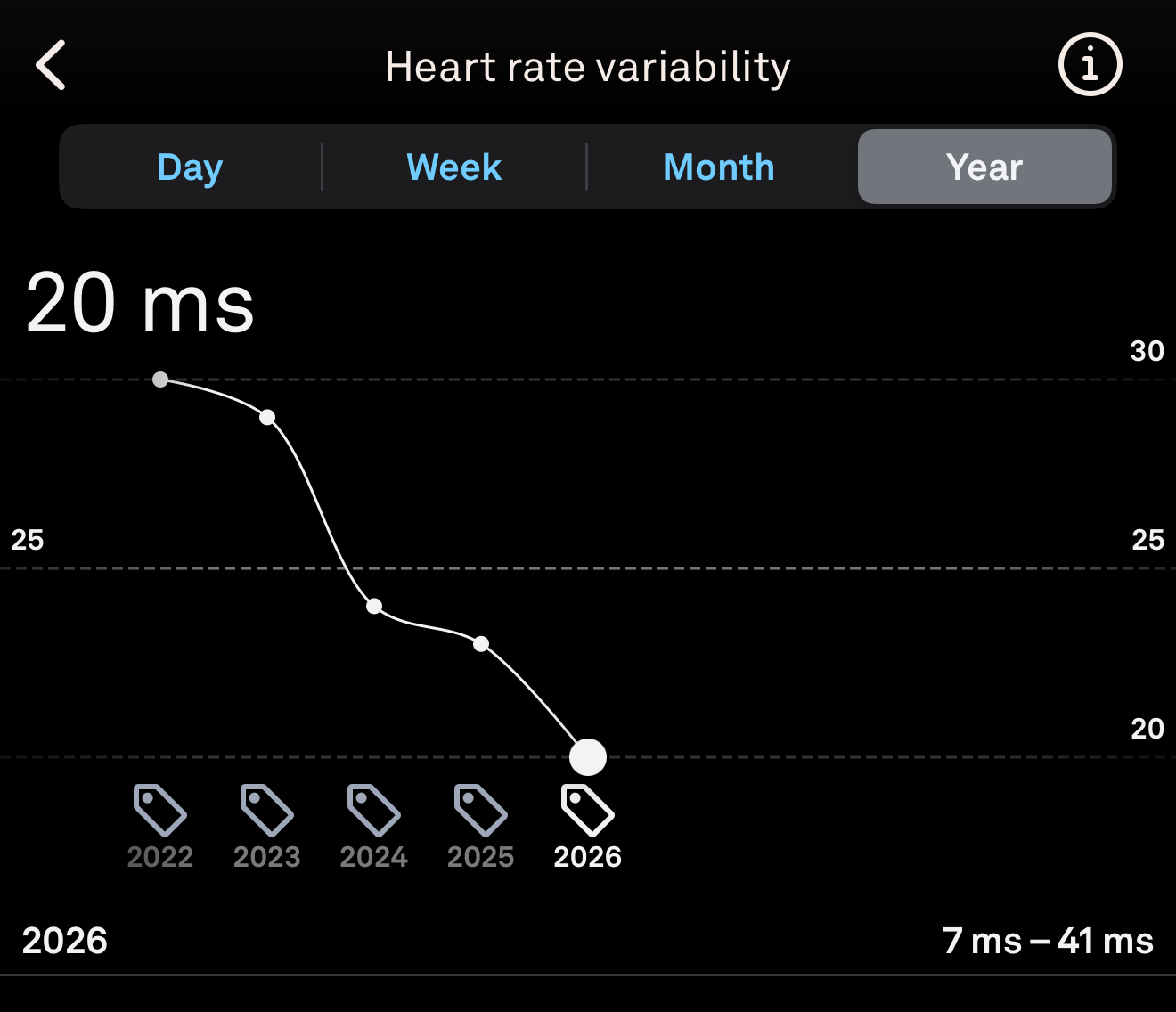
I’ve talked to other women who have seen the same frustrating trend. Some stopped wearing their rings because they got tired of being told, night after night, that something was wrong without being told what to do about it.
I eventually did my own version of the same thing.
I stopped paying attention.
Not because I thought the number was meaningless.
Because I didn’t know what lever to pull.
That’s three years of my nervous system, sitting in one screenshot, telling me something I wasn’t particularly interested in hearing.
Everything is fine.
The chart disagrees.
The 80/20 I had backwards
Here’s the part I hadn’t really understood.
The vagus nerve isn’t simply a command line running from your brain down into your organs. Roughly 80 percent of its fibers are afferent: carrying sensory information from the body toward the brain. A much smaller proportion runs the other direction.
That doesn’t mean the incoming signal is four times more important. Biology isn’t that tidy.
But it completely inverted the mental model I’d been carrying around.
I had spent years thinking about my brain as headquarters and my body as the thing waiting for instructions.
Meanwhile my body had been sending information upstairs the entire time.
And HRV - the number I had been staring at - isn’t a measurement of “the vagus nerve.” It’s one useful, narrow window into cardiac autonomic regulation.
I’d been looking through a keyhole and wondering why I couldn’t see the whole house.
What an actual expert thinks, minus the Instagram version
So I called Dr Mike Hunter, a gastroenterologist with two decades in academic medicine who used to head the department at Helen Joseph Hospital in Johannesburg.
His estimate, after years in practice: roughly 40 percent of what walked through his door was functional bowel disease.
Scopes clean. Labs clean.
Patient miserable.
Not nothing wrong.
Something we weren’t particularly good at measuring.
His diagnosis of medicine itself was almost annoyingly familiar: too many specialists treating one toenail each and nobody looking at the whole foot.
Which sounded a lot like my last three years.
One doctor looking at estrogen. Another at pancreatic enzymes. Another at bacteria. Me trying to optimize each answer as it arrived.
Scattered advice against single datapoints while I was sitting there holding the whole story.
Mike is also, by his own admission, a vagus nerve device user.
He uses one that clips to the tragus of the ear - Neuropod - rather than one worn on the neck , which he preferes to the one I have - Pulestto.
So what actually works?
This is where the internet gets predictably annoying.
There is real science here. There is also a very large wellness industry standing immediately adjacent to the real science with a credit-card terminal.
Slow breathing - around 6 breaths per minute - has surprisingly solid evidence for shifting HRV and autonomic activity.
It’s also approximately the cadence embedded in certain centuries-old prayer traditions, which apparently figured out biohacking before we had a word for it.
Humming, chanting and singing have plausible physiological mechanisms and some smaller studies behind them.
Cold exposure can alter autonomic activity, although the physiology is more complicated than “cold plunge stimulates vagus nerve,” no matter how many times someone writes it on Instagram.
And vagus nerve stimulation itself is real medicine. Implanted VNS has FDA-approved clinical uses. Certain non-invasive VNS devices also have regulatory clearance for specific indications.
That does not mean every consumer device promising to “tone your vagus nerve” is equivalent to the clinical technology.
Adjacent science is not the same thing as evidence.
That’s a distinction this industry could stand to tattoo somewhere visible.
None of these things is a cure.
That’s the part I’m finally getting.
A four-minute device session isn’t going to retune a nervous system that may have been adapting for years.
Neither, apparently, is putting a needle in my neck. I’ve already written about my stellate ganglion block: two blissfully quiet weeks followed by the gradual return of the noise.
At the time, I interpreted that as another intervention that hadn’t worked.
Now I’m wondering if I was asking it to do something no single intervention could do.
The part I don’t like
For three years, I thought that if I could find the one thing - one enzyme, one malfunctioning organ, one allergy, one bacteria - I could fix it and this would all magically go away.
The nervous-system hypothesis scares me precisely because there isn’t one lever.
I already meditate.
I already do breathwork.
I don’t walk around thinking, God, I’m so stressed.
And maybe that’s the point I find hardest to sit with.
What if you can become so accustomed to a certain level of activation that it stops registering as stress?
What if “I don’t feel stressed” and “my body isn’t stressed” aren’t actually the same sentence?
I don’t know.
And I want to be careful here.
I am not saying trauma caused my gut problems.
I am not saying SIBO isn’t real. Mine was real. Treating it helped.
I’m currently being evaluated for other actual biological explanations, too.
There may still be something we’re missing.
But SIBO can be the thing you find without necessarily being the thing that started the chain.
And after three years of looking harder and harder at the same place, I’m willing to entertain the possibility that the root cause isn’t another datapoint waiting to turn red.
Back to the psychic
So now I’m doing something that feels embarrassingly simple.
I’m breathing.
Not generic “I do breathwork” breathing. A deliberate daily protocol at a specific cadence, with my HRV and symptoms tracked alongside it.
I’m continuing hypnotherapy.
I’m looking at nervous-system regulation with the same obsessive curiosity I previously reserved for bacteria, enzymes and supplements.
Which is admittedly hilarious.
I may have responded to the realization that I over-optimize my health by creating a new protocol to optimize my nervous system.
Growth.
But this time I’m trying to ask a slightly different question.
Not: What number is broken?
Not even: How do I make this symptom disappear?
But: What happens if I treat all of this as one system instead of twelve separate problems?
I don’t know what the answer is yet.
That’s uncomfortable for someone who has spent three years trying to produce one.
Maybe the tests will find something.
Maybe my HRV won’t move.
Maybe I’ll do all of this for three months and discover the psychic was, in fact, just a psychic.
Or maybe she was right.
Maybe my body has been keeping score in a language I was too busy measuring to actually hear.
I’ll report back.
If this gave you something to think about, pass it on. Restack it for someone who’d argue with you, reply and tell me where you land, or subscribe if you’re new here. I read everything.
In Search Of is where I chase the questions the wellness industry is too sure about.
I liked your article. One thing noticed though is that we tend to think of our vagus nerve as something we have to “activate” or “stimulate”, when in reality approximately 80% of the fibres are sending information to the brain from the body. It’s more of a listener.
Maybe we should shift our perspective. “How can I stimulate my vagus nerve?” to “What messages is my body sending to my brain?” Sleep, diet, exercise, inflammation, metabolic health and gut bacteria all influence these messages.
Deep breathing and vagal nerve stimulation are tools that can help, but they won’t fix everything.
Perhaps it’s not just about stimulating the vagus nerve, but improving the environment it’s monitoring.