


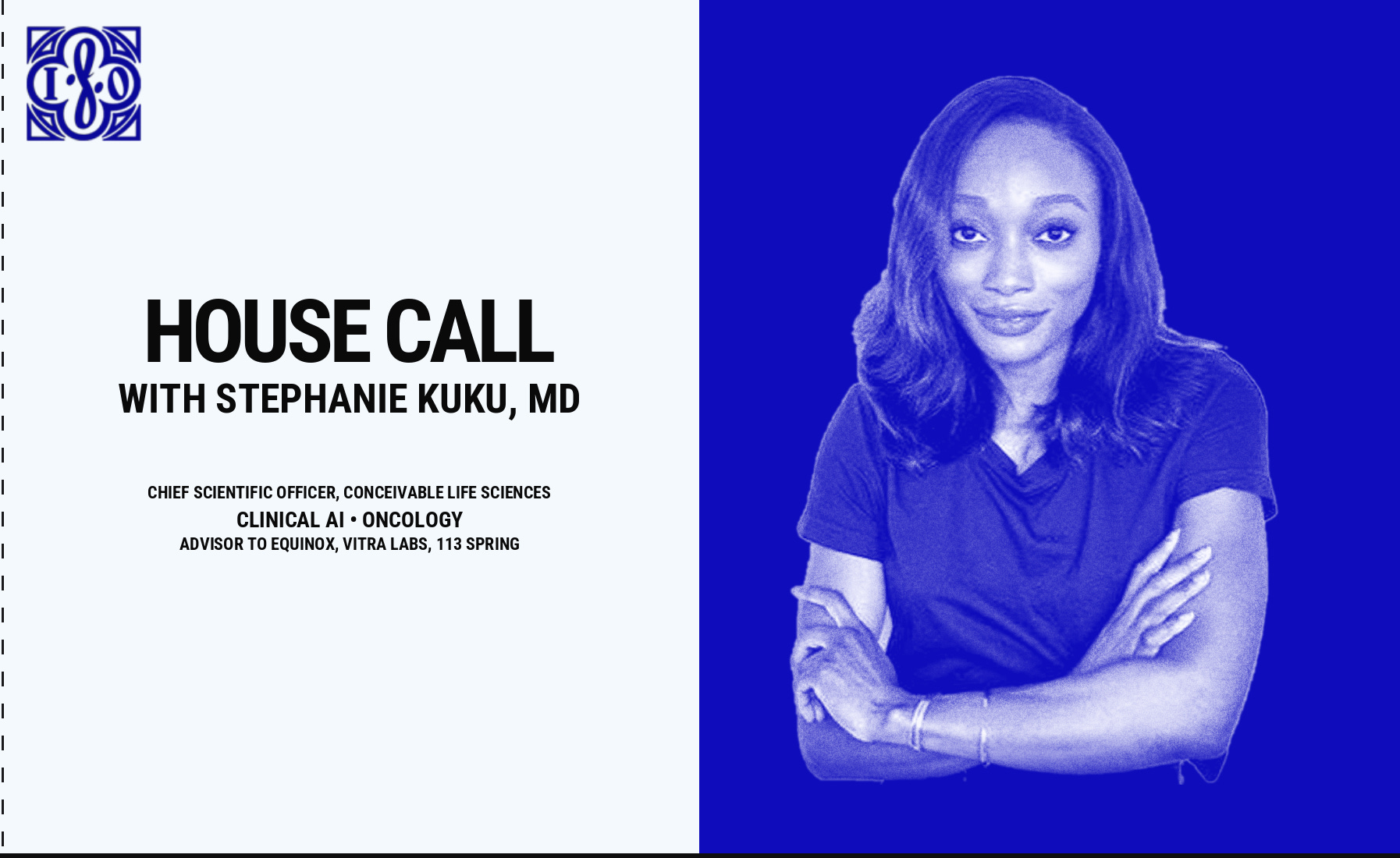
Disclaimer: This is part of In Search Of great people. I’m lucky to call Stephanie Kuku, MD a friend - an incredible scientist and doctor, a very stylish woman, and someone I keep overlapping with in the business world. She serves as a scientific advisor to both Equinox and 113 Spring, which feels fitting given how often our worlds seem to collide.
The below is a lightly edited, non-verbatim version of a call we had the other day.
You can also read more about Stephanie’s filter for wellness and longevity here and definitely recommend subscribing to her substack!
I spend a lot of time around people who are unusually informed about their health. Doctors, scientists, investors, founders. These are also people who take peptides they heard about on a podcast.
Intelligence, apparently, does not make us immune to Instagram.
That was one of the things Dr. Stephanie Kuku and I kept coming back to when we spoke. Stephanie trained in gynecologic oncology and clinical research before moving into health technology, AI and scientific due diligence. She now spends a lot of time looking at longevity products and asking a fairly basic question: does the science actually support what we’re being sold?
The problem isn’t that everything in wellness is bullshit. It isn’t.
The problem is that we have become very bad at distinguishing early science from bad science.
Medicine has informed consent. Before an intervention, someone is supposed to explain the potential benefit, the risks, the alternatives and what we don’t know.
Wellness doesn’t really have an equivalent.
A supplement can tell you about the study on one of its ingredients without testing the actual formulation. A peptide can be sold alongside an extremely convincing biological mechanism despite having little long-term human safety data. A finding in mice can travel remarkably quickly from PubMed to a $180 bottle.
I don’t think the answer is to stop experimenting. That would be both unrealistic and, frankly, boring. Some of the most interesting ideas in longevity are interesting precisely because the science is still developing.
But curiosity works much better with due diligence.
So I asked Stephanie to give me hers.
Julia: You spend a lot of time evaluating health technology and longevity products. Why are even very sophisticated people so susceptible to wellness marketing?
Stephanie: We’re consuming an enormous amount of health information online, and nobody is immune to that influence. Doctors aren’t immune. CEOs aren’t immune. Investors aren’t immune.
The problem is that what you see is usually one-sided. You’re presented with the potential upside of an intervention without the equivalent conversation about the risks, limitations or quality of the evidence.
In medicine, we have informed consent. If I’m recommending an intervention, I have a responsibility to explain what could happen, what the alternatives are and what we don’t know.
That balance largely disappears when something becomes a consumer wellness product.
J: Which is interesting because the consumer can mistake more access to information for being better informed.
Stephanie: Exactly. And marketing is extremely sophisticated.
Something can say “science-backed” because one ingredient has been studied. But was the actual product studied? At this dose? In this formulation? In people like you? For the outcome they’re advertising?
Those are completely different questions.
J: I think this is where longevity gets particularly messy. There is a tendency to divide everything into “science-backed” or “bullshit.” But early science isn’t the same thing as bad science.
Stephanie: Absolutely.
You have to look at where the science actually is.
There may be a plausible mechanism. There may be good animal data. There may be early human data. That’s promising science.
The problem starts when the claim runs significantly ahead of that evidence.
J: So how do you personally diligence something? Say I send you the newest longevity supplement everyone suddenly seems to be taking.
Stephanie: Before I even get to the product, I start with foundations.
Are you eating well? Are you exercising? Are you sleeping? How is your mental health? How is your community?
Because if those aren’t addressed, you have to ask what exactly you’re expecting the product to compensate for.
Then I ask about indication: what are you actually trying to change?
That sounds obvious, but people often buy a supplement without being able to clearly answer that question.
Then you look at the evidence. What studies exist? Were they done in humans? Were they done on the actual product or only one of its ingredients?
Then mechanism: is there a biologically plausible reason this should do what is being claimed?
And finally risk versus reward.
J: The indication point might be my favorite because longevity has created this category of things we take “for longevity,” which is not actually an indication.
Stephanie: Right. What outcome are you trying to achieve?
If you don’t know, it’s very difficult to determine whether something is working.
J: Let’s talk about mechanism because I think this is where smart consumers can get tricked. Give me enough molecular biology and almost anything can start sounding compelling.
Stephanie: A mechanism is important, but it isn’t proof of an outcome.
GLP-1 is a good example. We understand the mechanism and have strong clinical evidence for specific indications. But that doesn’t mean you can take every downstream biological observation and suddenly claim that GLP-1 drugs prevent every disease.
There has to be a chain between the mechanism, the intervention, the population and the actual outcome you’re claiming.
J: This happens constantly with supplements too. There might be a paper on vitamin C, another on creatine, another on some botanical, and suddenly putting all three into a beautiful jar makes the jar clinically validated.
Stephanie: Exactly.
Ingredient-level evidence isn’t automatically product-level evidence.
You need to ask whether the finished formulation has actually been studied, whether the doses match the evidence and whether combining those ingredients changes anything.
J: Why don’t more wellness companies just run the studies?
Stephanie: Incentives.
Clinical trials are expensive. They’re slow. And there’s also a business risk: what happens if you run the trial and it doesn’t show what you’ve already been marketing?
If the product can already be sold without that evidence, there isn’t always a commercial incentive to generate it.
J: Which creates a slightly insane asymmetry. The consumer takes the biological risk while the company avoids the evidence risk.
Stephanie: That’s why I think consumers have to start demanding better evidence.
J: Peptides feel like the perfect example. They are increasingly normal in longevity circles, including among young healthy people, while long-term human data for many of them is extremely limited.
How do you think about something where the mechanism is exciting but we genuinely don’t know what happens after someone uses it for ten or twenty years?
Stephanie: That’s exactly where risk-reward becomes important.
Absence of evidence of harm isn’t the same as evidence of safety.
If you’re treating a serious condition, you may rationally accept more uncertainty. If you’re a healthy 30-year-old trying to optimize something marginal, your risk tolerance should probably look very different.
And some risks may not become apparent for years.
J: Rapamycin is another fascinating one because there is legitimate longevity science around the pathway, very compelling animal work, and growing human research. But that sentence can very easily become “rapamycin makes humans live longer.”
Stephanie: And we don’t have evidence to make that claim.
This is where you have to distinguish animal evidence, mechanistic evidence and clinical evidence.
The exciting thing is that rigorous studies are being done. That’s exactly what we need. But until those results exist, we should be precise about what we know and what we’re extrapolating.
J: Do consumers actually need to learn how to read scientific papers to do this well?
Stephanie: No.
I don’t think everyone needs to become a scientist.
You need better questions.
What is this supposed to do?
Was the actual product studied?
Was it studied in humans?
How many people?
Does the dose in the study resemble the dose I’m taking?
Who funded the research?
What are the risks?
And is there something much simpler with better evidence that achieves the same thing?
AI can actually be very helpful here. You can give it a claim and ask it to find the evidence behind that specific claim rather than just accepting “clinically proven” on a website.
J: What’s funny is that after spending all this time evaluating longevity products, your own stack is relatively boring.
Stephanie: Very boring.
I don’t generally take supplements unless I have a reason. I’ll take things like folate, vitamin D or magnesium when they’re indicated for me.
But I also use things that wouldn’t necessarily score perfectly on a rigorous longevity evidence framework. I like skincare. I use some beauty devices. They make me feel good.
And that’s okay.
Not everything has to extend lifespan to have value.
J: I actually love that distinction.
We should be allowed to buy something because it feels good, looks beautiful or gives us twenty minutes when nobody is speaking to us.
We should just know that’s the return we’re buying.
The problem begins when a luxury experience gets repackaged as a biological certainty.
Stephanie’s due diligence test
The next time something lands in my Instagram feed promising better mitochondria, younger cells or an unspecified amount of “hormone balance,” I’m trying five questions before my credit card gets involved:
1. What am I actually trying to solve?
“Longevity” isn’t an indication.
2. What is the evidence — and what was actually studied?
Humans or mice? Ingredient or finished product? Same dose? Same outcome?
3. Does the mechanism make biological sense?
Plausibility matters. It just isn’t the same thing as proof.
4. How large is the gap between the evidence and the marketing claim?
This might be the most revealing question of all.
5. What is my downside?
Not just “could this work?” but “what am I risking for the possibility that it does?”
I’m adding a sixth for myself:
What would change my mind?
Because I’m still going to experiment.
I just want to get better at knowing whether I’m participating in promising science, paying for a nice experience, or accidentally funding someone’s very beautiful mouse study.
Hi, I’m Julia. I spent the last six years working at the intersection of fitness, wellness and longevity, most recently leading partnerships at Equinox. Now I’m building In Search Of and talking to the people I think are asking the most interesting questions about how we live longer - and better.
If you liked this HOUSE CALL, follow along, share it with someone who would too, or send me the person you think I should call next.