


Eight Sleep launched Pod 6 this morning, its smallest - and, according to the company, most powerful - Pod yet.
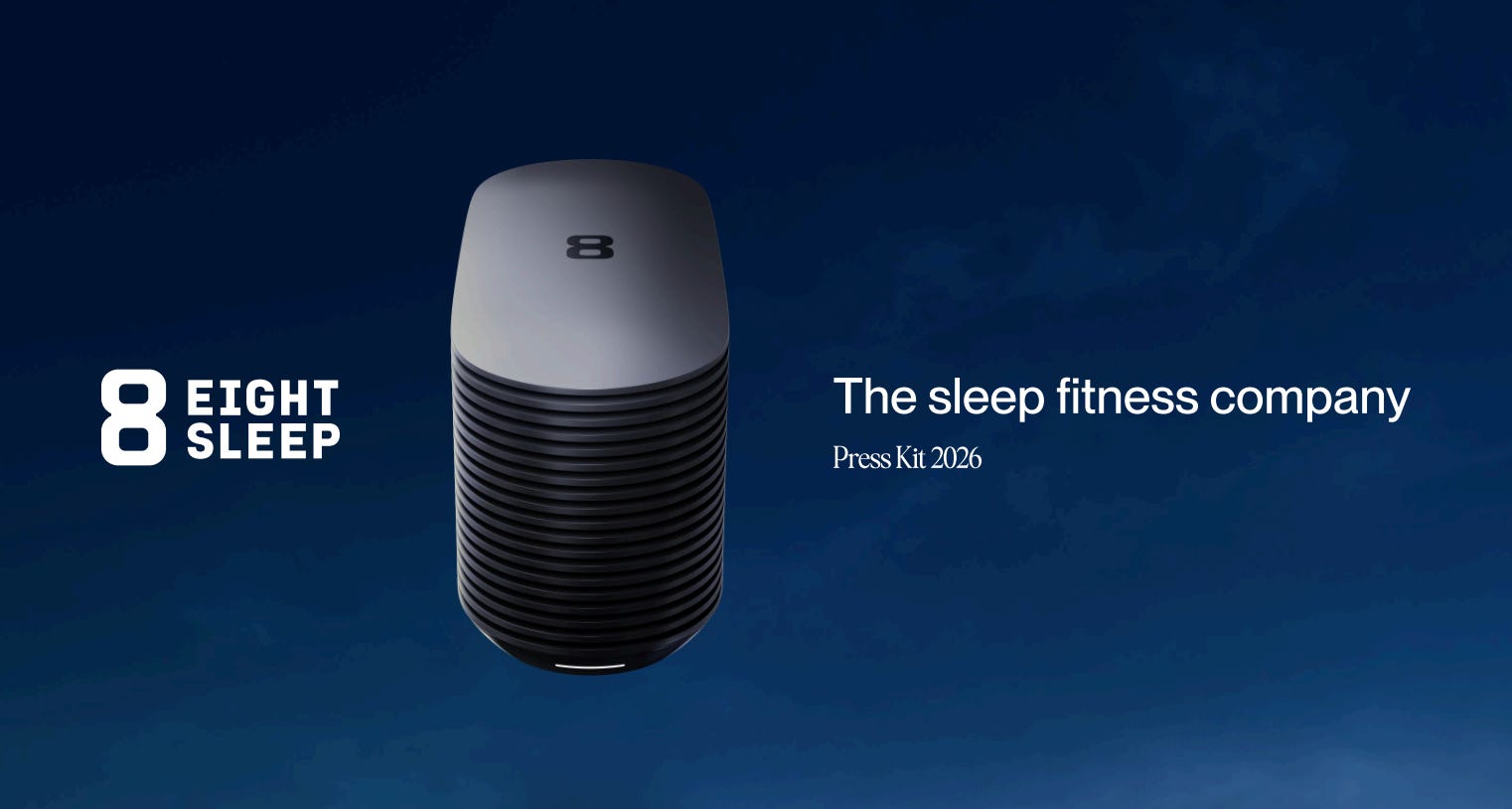
The most immediately useful upgrade is fairly unsexy: they finally made the Hub small enough to fit under most beds. It’s half the size of the previous generation, despite temperature adjustments that Eight Sleep says are 20% faster.
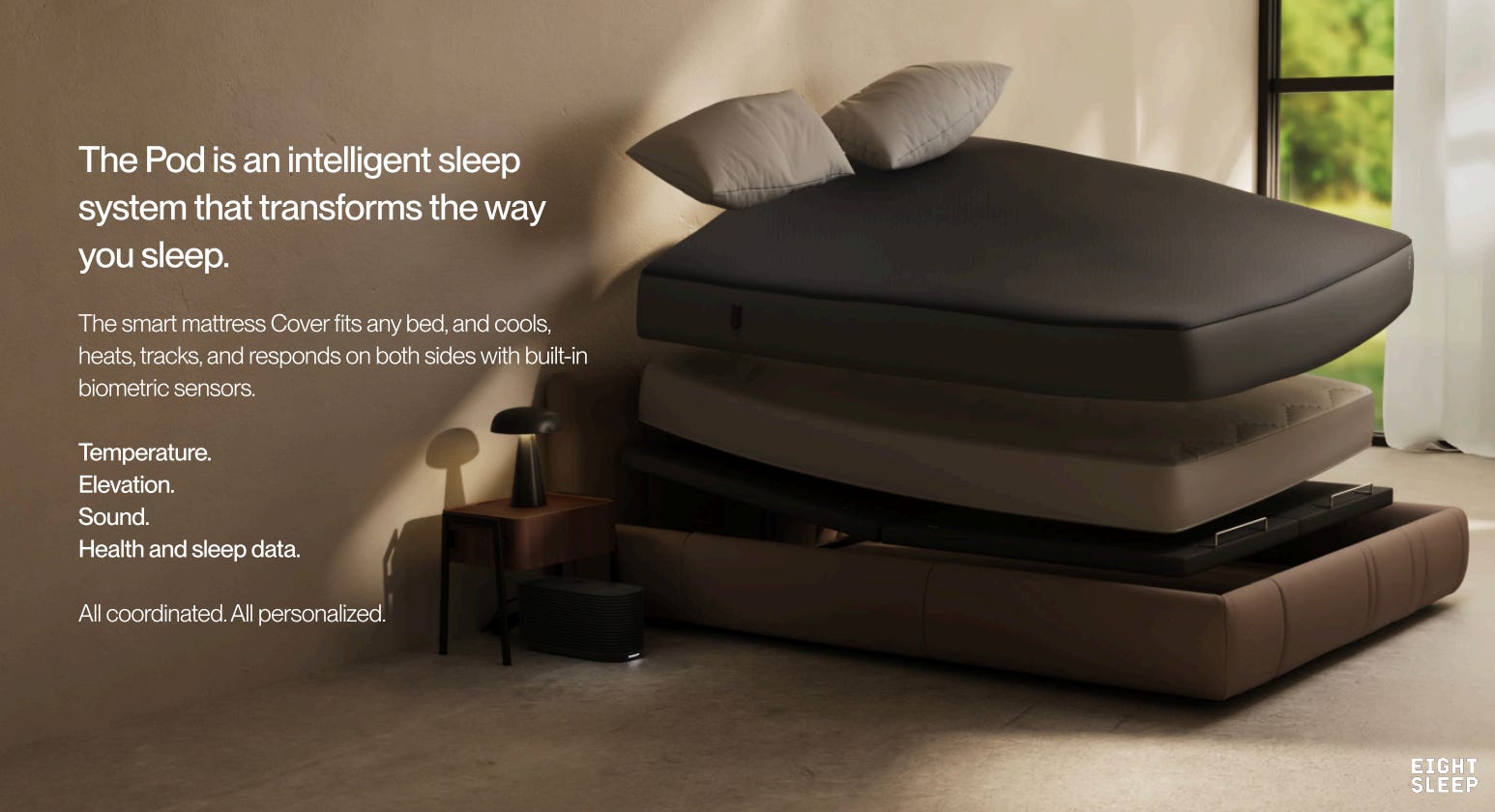
The Cover is where things get more interesting. Pod 6 goes from two biometric sensors to 18, tracking heart rate, HRV, breathing, snoring and sleep stages from underneath you. Eight Sleep says the added density means it can better distinguish between two people sleeping close together—or you versus the dog who has somehow acquired half your mattress.
There are also new Solo sizes that cover only one side of a Queen or King, plus Twin and Twin XL options. They start at $1,999, versus $2,699 for the full-bed version. For a product that has historically required convincing both yourself and potentially the person sleeping next to you that your mattress needs a computer, this feels like a smart move.
And then there is Autopilot, which I increasingly think is the more interesting part of the product. It takes all of that data and automatically changes temperature through the night based on your sleep, environment and patterns. Depending on the Eight Sleep setup, the system can also adjust elevation and sound.
The mattress is beginning to watch, learn and respond.
Which brings me to a confession: I don’t own one.
This is slightly peculiar given how many sleep and health devices I have tried over the years. I’ve been an Oura user forever. I track my HRV. I’ve spent an unreasonable amount of time thinking about sleep environments. And sleep is actually one of the things I’m naturally pretty good at.
There were a few reasons I never bought an Eight Sleep.
The first is embarrassingly practical. Every year I tell myself this is the year I graduate from a Queen to a King. Somehow this has prevented me from buying an Eight Sleep for several years while also, importantly, not resulting in the purchase of a King bed.
The second is data.
I already measure my sleep with Oura. I’m not convinced that knowing my sleep score twice makes me twice as informed.
This is something I think about increasingly as we put more technology on our bodies and in our homes. There is a point at which more measurement stops producing more understanding. I don’t need three devices congratulating me for getting eight hours of sleep.
But the bigger hesitation was slightly more woo-woo.
I try to remove electronics from my bedroom, particularly anything sitting close to where I sleep. So voluntarily lying for eight hours on top of something filled with sensors, plugged in and connected to Wi-Fi always felt somewhat incompatible with my attempts to reduce EMF exposure.
I know. The EMF conversation can get weird very quickly.
She had her bedroom professionally tested (thanks to Lightworkhome which is worth looking at!) and also took measurements herself, and reported very low EMF at the sleeping surface.
To be clear, someone’s home measurements aren’t a clinical study, and I’m not declaring the EMF conversation settled. But it did make the image I had in my head - me marinating in an electromagnetic mattress for eight hours - look somewhat less convincing.
Unfortunately for my bank account, Pod 6 also removes another excuse: with the Solo version, I don’t even have to wait for the mythical King bed.
So I started looking more closely at what Eight Sleep has been doing.
And that’s when the new Pod became the less interesting part of the story.
Because your mattress company would now like to know your medical history.
Eight Sleep recently partnered with HealthEx, a company that lets consumers access and share their medical records (you can pull your own with HealthEx connector within Claude). The integration means Eight Sleep can, with a user’s permission, bring information like medical conditions, medications and lab results into the same ecosystem that already knows how you sleep every night.
That is a fascinating sentence.
For years, Eight Sleep knew what happened to you between approximately 11 PM and 7 AM.
Now it can begin to know why.
And at the same time, the company is moving into sleep apnea. Eight Sleep says it is pursuing regulatory clearance in Abu Dhabi and the U.S., and is studying whether its technology can help manage the condition.
This is where a very good wellness product starts becoming something else.
A mattress that tells me I slept badly is wellness.
A mattress that detects something clinically relevant about my breathing, understands the medical context around it and can potentially change my physical sleeping position in response starts getting awfully close to healthcare.
I’ve been obsessed with this transition for years.
At Equinox, we launched Optimize, a roughly $40,000 program that brought together advanced diagnostics, physicians, nutrition, training and recovery. The interesting part to me wasn’t that we were adding more wellness services. It was watching the line between wellness and healthcare become increasingly artificial.
Healthcare has traditionally owned the serious stuff: diagnoses, prescriptions, labs, medical records, interventions.
Wellness got everything that happened in between: sleep, exercise, food, recovery, stress.
Except everything that happens “in between” is most of your life.
Your body, inconveniently, does not recognize the organizational chart we’ve built around it.
Sleep affects blood pressure and glucose regulation. Exercise affects cardiovascular and metabolic health. Medications can change sleep and heart rate. Hormonal changes can alter temperature and sleep. What happens during the 8,700 or so hours a year you aren’t sitting inside a doctor’s office is not background information. It is your health.
And wellness companies have become remarkably good at capturing it.
Oura sits on your finger all day and night. WHOOP sits on your wrist. Eight Sleep gets roughly eight hours of extraordinarily intimate physiological information every night.
Now they’re all starting to move upstream.
WHOOP has moved into blood testing and medical-record integration. Oura has been expanding into glucose and clinical data. Withings has an FDA-cleared under-mattress sensor that can aid in diagnosing obstructive sleep apnea. Apple Watch has an FDA-authorized sleep apnea notification feature.
This looks less like a collection of product launches and more like the early stages of a structural shift.
Healthcare companies have spent years trying to create a more continuous relationship with patients.
Wellness companies started with the continuous relationship.
Now they’re adding healthcare backwards.
I think that’s important.
Because the company that sees you twice a year has one kind of information about you. The company whose product you sleep on 365 nights a year has another.
Neither picture is particularly useful alone.
Which is why I’m also paying attention to HealthEx. Infrastructure companies like it aren’t as fun to talk about as a $3,000 bed, but they may end up being incredibly consequential. HealthEx is effectively building plumbing between clinical records and consumer health products. WHOOP has also partnered with the company.
The walls around the medical record are beginning to get more permeable at exactly the same moment consumer devices are collecting better longitudinal data.
Eventually those two pictures meet.
And once they do, I think the more interesting question becomes what the device can actually do.
For roughly the first decade of quantified self, we became very good at measurement.
Steps. Sleep. Heart rate. HRV. Glucose. Temperature. VO2 max. Biological age. Scores for things I didn’t realize required scores.
Then came interpretation: readiness scores, recovery scores, recommendations, AI coaches telling us to go to bed earlier.
The next phase is intervention.
Measurement → interpretation → intervention.
Eight Sleep is a particularly interesting example because it already has something most wearables don’t: the ability to physically change your environment.
If it detects that you’re overheating, it can cool the bed.
If you’re snoring, certain configurations can change elevation.
The feedback loop doesn’t have to end with a notification telling you to do something tomorrow. The system can potentially do something while you’re asleep.
That is a fundamentally different product.
And there is some actual science behind the temperature piece.
A 2024 study of 54 adults using the Eight Sleep Pod found improvements in certain sleep measures alongside lower sleeping heart rate and higher HRV under some temperature conditions. Eight Sleep employees were among the authors, which is worth knowing when interpreting the results.
A separate randomized crossover study in 34 healthy adults also found that individualized temperature control altered aspects of sleep and thermoregulation. The studies are still small, and they are nowhere near evidence that a smart mattress is necessary for good sleep. But they make temperature manipulation considerably more interesting than another wellness feature searching for a mechanism.
The sleep-apnea work will be a much bigger test.
Because there is a meaningful difference between making a healthy person sleep slightly better and treating or managing a medical condition. That requires stronger evidence, regulatory scrutiny and a very different standard for getting things wrong.
I’m excited about wellness moving into healthcare precisely because I think that distinction matters.
Early science isn’t necessarily bad science. But the closer a product gets to medicine, the higher the evidentiary bar should become.
For now, Pod 6 is still primarily a very sophisticated sleep product. It’s smaller. It’s faster. It has considerably more sensors. It costs less to get into than the previous generation. And the Solo configuration makes it much easier for someone like me to rationalize buying one.
But six generations into building a mattress, Eight Sleep seems increasingly interested in building something much larger around it.
We have spent the last decade putting sensors everywhere.
Maybe the next decade is about what happens when those sensors finally have enough context - and enough permission - to do something useful.
And, annoyingly, I may have finally run out of reasons not to buy an Eight Sleep.