


Nervous system seems to be taking over all my social feeds recently - and (probably) for a good reason.
If you decide to stop reading this newsletter here - this is my conclusion on the topic:
If you want to take care of your health in 2026, nervous system regulation is (definitely) the place to focus.
But there is as much art as science as to the how - or to say it differently, you actually cannot (fully) biohack it.
Here’s why it matters: Nervous system is the communication network between your brain and body that controls everything from heart rate and digestion to immune function and stress response, constantly assessing whether you're safe or under threat
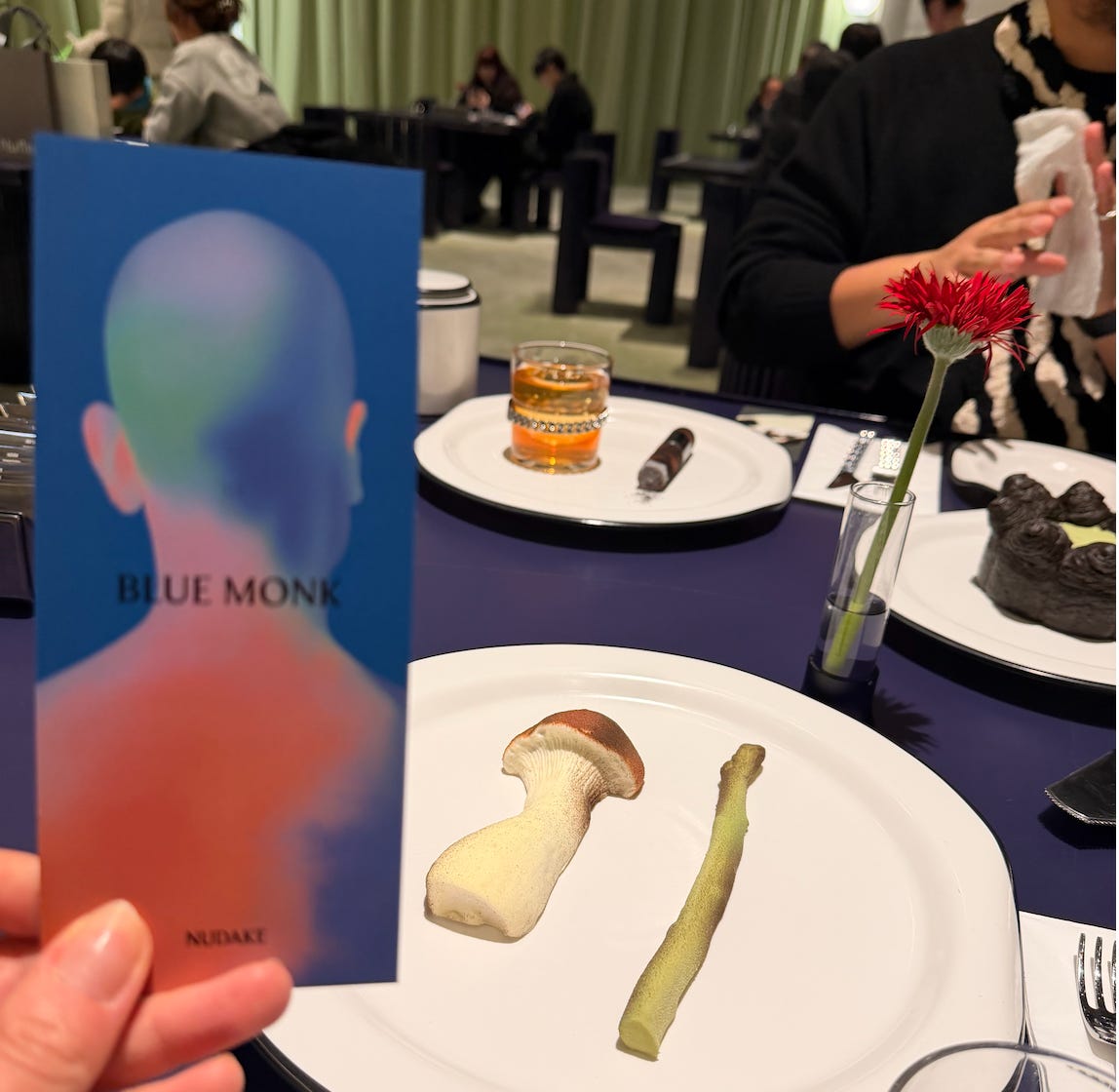
Blue Monk an image made for a custom tea blend from Gentle Monster’s cafe brand Nudake; next to it a dessert in vegetable form, which definitely messes with your senses! If you have SEOUL longevity recs, send my way!
When it’s dysregulated, everything else fails: your sleep, your immune system, your ability to recover from stress, even how well your body receives the supplements and protocols you’re investing in.
And for certain personality types (👋 Type As), it's often hard to spot when it's dysregulated until we hit a wall: burnout, unexplained fatigue, constant colds, weight gain, you name it.
But the answer isn’t: stress less…
…in fact, many of us (hi Type A again) learn to operate only in fight-or-flight mode, making it our default state where we don’t even register feeling stressed anymore.
It’s also not about eliminating stress but about building resilience so your body can actually bounce back from stress into true parasympathetic relaxation. Stress is good (evolutionary speaking)
Let’s dive in.
Read to learn why it’s misunderstood, what Covid and nervous system dysregulation have a lot in common and how to think about it, why supplements and protocols timing matter, our recent event on the topic in NYC and my personal (mostly Equinox) recs I go to in NYC to optimize my system.
Disclaimer: This post is inspired by early proponents in the longevity space of topic such as our Dr Tamsin Lewis (who even coined the term Wellgevity to account for exactly that), as well as learnings from of the recent events we did with Dr Sogol Ash and The Altar (sign up for waitlist here), and of course my own health!
The Problem: We’re All Running From Bears
I’ve been on my own longevity journey for years - not enough energy, gut issues, the works. I’ve had COVID five (?) times - hard not to pinpoint when my health issues really started.
Here’s the thing: I’m not alone. There’s probably a reason this video by Doctor Steven Murphy went viral on Substack with half a million views: people are connecting dots between viral exposure and what feels like accelerated aging.
And here’s where it gets interesting: your mind, nervous system, and immunity are completely intertwined. Viruses like SARS-CoV-2 aren’t just temporary infections. The spike protein attacks ACE2-rich tissues-lungs, heart, blood vessels-causing long-term vascular damage and cognitive decline. ORF8 disables your interferon signaling, allowing the virus to evade detection while triggering massive inflammation.
This leaves your immune system in chronic activation - exhausted, dysregulated, prone to autoimmunity. The result? Immune burnout. Chronic inflammation. Mitochondrial dysfunction. The exact cascade that tanks your nervous system and keeps it stuck in threat mode.
As part of our ongoing programming residency at 113 Spring in NYC (go check it out), last week we hosted an event on exactly that topic with Dr. Sogol Ash and The Altars’ founders Sheba Jafari and Henrique De Castro. The biggest pattern Dr. Ash sees in founders and high performers confirms it - its not lack of discipline or taking care of themselves. It’s a dysregulated nervous system despite all that.
And here’s the catch: if your nervous system is stuck in threat mode, your body won’t receive the supplements, peptides, or protocols you’re throwing at it. The system needs to feel safe enough to heal first.
What to Actually Do: You Can’t Biohack Your Way to Safety
Here’s what I’m learning from Dr. Tamsin Lewis, our head of expert community - most of us are approaching this backwards. We think nervous system regulation is another thing to optimize - breathwork sessions, therapy appointments, yoga classes, wearables, protocols. These tools help. But they’re not the foundation.
This is why so many high-functioning people keep adding more tools and feel increasingly dysregulated.
Your nervous system doesn’t respond to optimization. It responds to conditions. When your body consistently receives signals that its environment is predictable, relationally safe, and metabolically supported, regulation emerges naturally.
What this actually looks like? Movement that feels supportive rather than punishing, self-compassion that reduces internal threat, nourishing connections, play and laughter, shared meals. Your heart rate variability (HRC), vagal tone, and immune signaling respond to these conditions just as powerfully as they respond to advanced techniques.
Here is a list I pulled from Dr Tam and others in this space:
Start with the foundations:
Sleep: Aim for 90+ minutes of deep sleep - that’s when repair and immune function rebuild
Protein in the morning: Signals safety, stabilizes blood sugar and cortisol
Daily downshifts: 20 minutes before bed doing anything that doesn’t require you to be “on” (that means, don’t wake up and scroll your thing first thing)
Movement that feels supportive: Strength training that signals vitality with focus on breathing, not workouts that feel like punishment
Nourishing connections: Shared meals, play, laughter - oxytocin matters for REM sleep and bonding
Self-compassion: How you talk to yourself creates or reduces internal threat
Then add targeted support:
Vagus nerve work: Breathwork, humming, or tech like Pulsetto
Sauna 3x/week: 20 minutes of actual sweating for parasympathetic activation and immune support
Reduce cognitive overload: Less doomscrolling is a good start
Support immune and mitochondrial function (especially post-viral):
NAD+ precursors (1MNA, NMN, NR): Mitochondrial repair and cellular energy
Polyphenols (Resveratrol, Fisetin, Quercetin): Natural senolytics that clear damaged cells
DHA (Omega-3s): Repairs vascular damage and reduces neuroinflammation
HBOT: Restores immune function and repairs viral-induced inflammation
Thymosin Alpha-1: Boosts T-cell function and reduces chronic inflammation
And then there are peptides (which I’m pro, as long as you can verify your source and your vial, an impossible task when all of this is coming from China. Here’s an article from NYT on just that).
Get the data:
HRV (Heart Rate Variability): tracks your nervous system’s ability to shift between sympathetic and parasympathetic states. Mine sits below 30 when it should be around 100. Oura, Whoop, Apple Watch etc. measure it
Cortisol patterns: DUTCH test, or at-home devices like ElI Health or Lumen
Blood work: cortisol, or inflammatory markers through Function Health
Tip: look at your DHEA levels on next blood test. DHEA is the precursor to all your hormones and when it tanks, your body is telling you it is interpreting everyday life as danger.
Feelings: “Not feeling like yourself” or “not 100%” is equally as valid data point
My NYC Spots
HBOT (hyperbaric):
Equinox Domino
Extension Health
NextHealth
Sauna:
Equinox Hotel Spa
Equinox Hudson Yards (female locker only)
Equinox Domino
Equinox Park Ave (infrared; side note compression boots and red light therapy is part of the membership in this location - a hidden secret; yw)
Clean Market Battery Park or 54th (infrared)
The Altar (opening soon) - I am biased as founding member but go sign up!
Dr Sogol Ash & Sheba talking about nervous system regulation at 113 Spring
Bottom line: Many complaints - anxiety, exhaustion, brain fog, gut issues - are less about mindset and more about autonomic load. The system isn’t broken. It’s asking for support.
Repair begins when your body can downshift without bracing, and when everyday demands stop being interpreted as danger. That’s what 2026 should be about.
This really lands. I love the line that the nervous system responds to conditions, not optimization; that’s exactly what we see clinically when high-performing people keep adding “tools” yet stay stuck in threat physiology.
From a physician-scientist lens, I’d translate your thesis into an allostatic load model: when sleep debt, glycemic volatility, social disconnection, and cognitive overload stack up, the autonomic system doesn’t “fail,” it adapts, often into a chronically sympathetic, low-variability state. HRV then becomes less a “score to win” and more a readout of whether the organism perceives predictability + safety + adequate recovery capacity.
I also appreciate you linking post-viral illness/Long COVID to this conversation. Many patients describe a persistent “wired but tired” phenotype—orthostatic symptoms, sleep fragmentation, exertional intolerance—where the most helpful approach is exactly what you outline: rebuild the foundations, pace intelligently, and create repeatable downshifts. In that context, supplements/peptides can be adjuncts, but they’re not a substitute for restoring the baseline signals of safety.
If there’s one takeaway I hope readers keep: you can’t shame your autonomic nervous system into regulation. You can only give it the inputs that make regulation possible—light, sleep timing, stable meals, restorative movement, connection, and fewer daily “false alarms”.