


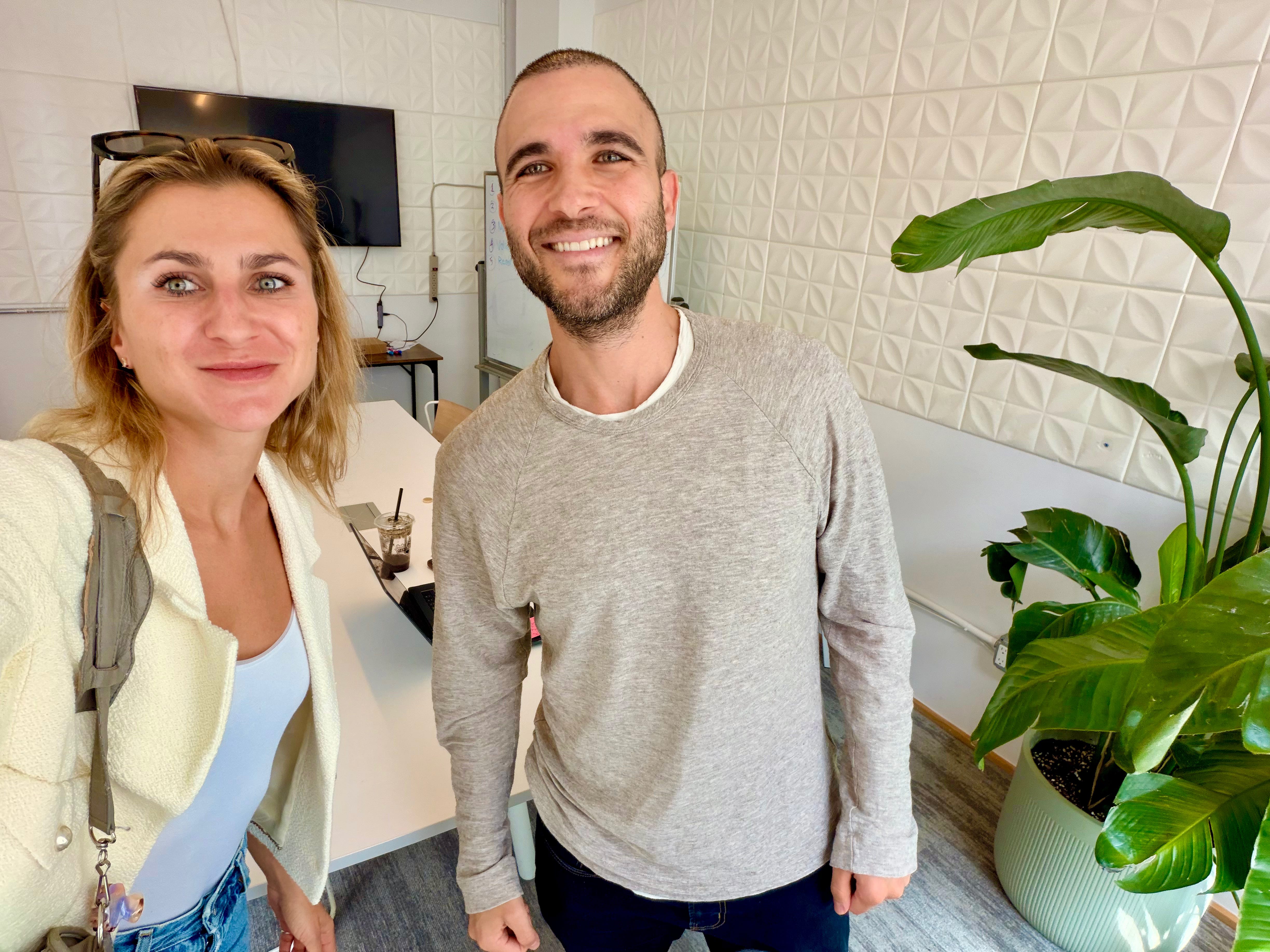
I keep mapping longevity to find the places it has been built for real. Skin is not one of them yet, which is strange, because it is the organ every one of us watches age in the mirror every single day. I sat down with Simon Sakhai - in the Antler offices where he works out of these days - who has spent the last few years building inside that gap, to work out why the most obvious longevity category is the one running furthest behind. This is a House Call.
Preview: Apply here to join invite only group chat on skin longevity with curated scientists, doctors and founders here.

WHO I TALKED TO
Simon came to longevity sideways. He was running a sleep startup when someone dragged him to a talk by people who said, out loud, that they wanted to cure aging. He thought they were crazy. Then he sat through it. “This completely changes how I think about everything,” is how he describes walking out.
The second time his thinking flipped was about skin. He started working with a scientist named Francois, two decades in longevity molecule discovery and more than a decade in cosmetics, who had led innovation and longevity research at a European cosmetics company doing around 700 million dollars. Simon built a whole-body longevity platform called Jung+, added a skin formula almost as a side quest, and is now building a skin-longevity supplement company. The science, in his words, blew his mind the way longevity itself first did.
I have heard a lot of founders say their mind was blown. I went anyway, because the thing he kept circling is one I think the whole industry has wrong.
THE 500 DALTON PROBLEM
Here is the pearl Simon handed me, and it is the one to keep.
There is a rule in dermatology called the 500 Dalton rule. A Dalton is a unit of molecular size. For a topical ingredient to cross the skin barrier, it has to be smaller than roughly 500 Daltons. The epidermis is, in Simon’s framing, a wall. Hundreds of millions of years of evolution engineered it to keep things out. Above 500 Daltons, the molecule mostly does not get through.
Now look at what the anti-aging shelf is actually selling you. Hyaluronic acid, the molecule everyone wants for plumpness, runs in the tens of thousands of Daltons and often far higher. Topical collagen and copper peptides are large too. The aging machinery they are supposed to reach, collagen, fibroblasts, the dermis, all of it sits below the wall. The molecules that are supposed to fix it cannot get down there.
“The difference between the mechanistic reality and what the skincare industry is selling is absurd,” he said. Hyaluronic acid sitting on top of your skin can give you surface hydration. Surface hydration is not aging. The organ needs hyaluronic acid inside it to bind water. Painting it on the wall does not put it in the room.
I want to be fair to the shelf, and so was he. Some topicals genuinely work. Retinol changes the biological age of skin, full stop. Microneedling improves delivery. “Many of them are crap,” he said of in-clinic treatments, “but some of them do actually alter biological aging.” The point is not that topical is useless. The point is that the dominant format is sold as if it reaches a place it physically cannot.
“YOU NEED TO SWALLOW YOUR SKINCARE”
That was my reframe back to him, and he took it. If the wall keeps things out, you feed the organ from the bloodstream instead. Ingest it, let it reach every organ system, skin included.
The feedback he describes from the supplement they built is the kind founders inflate, and he knows it. “This isn’t founder bullshit,” he said, before telling me the one that made me laugh. A customer’s podiatrist, of all people, told her that her feet were looking younger. Feet. The part of you nobody is putting serum on. If something is showing up on the skin you ignore, the signal is coming from inside.
Hold this loosely. These are anecdotes, not a trial. Glow is not a biomarker. The honest version of the inside-out thesis is that the mechanism is sound, systemic delivery reaches tissue that a cream cannot, and the human evidence for swallowing your way to better skin is still thin and mostly funded by the people selling the capsules. Simon’s own framing is the right one anyway: skin is a whole-body output. “The skincare industry has been trying to sell people a really narrow format that can maybe move five percent of the needle,” he said. Sleep, nutrition, exercise, the actual drivers, never made it into the bottle.
TWO ROOMS THAT DON’T TALK
So why is skin longevity behind body longevity by years, when it is the most visible aging any of us experience?
Simon’s answer is the most useful thing he said all conversation. “Dermatology sits in one ecosystem and echo chamber, and longevity aging biology sits in another.” Two rooms. Both full of smart people. Both curious about each other. Neither built to talk to the other. The science of aging lives in one. The customer who actually cares about looking older lives in the other. Nobody owns the hallway between them.
His word for the whole category is toddler. “Skin longevity feels like a toddler learning to walk.” Three to five years behind the rest of longevity, by his count, and saddled with a problem the rest of longevity does not have. The beauty industry is a behemoth. It has speed, money, and enormous momentum, a giant ship already pointed in one direction. Longevity asks it to turn the whole ship. Ships that size do not turn because the science changed.
THE TELL: A LONGEVITY MOLECULE IN A DAY CREAM
If you want proof the science is being bent toward the customer instead of the other way around, follow the smartest money.
In 2024, L’Oréal and Nestlé put roughly 66 million dollars into Timeline, the Swiss biotech behind Mitopure, a purified form of urolithin A spun out of EPFL. Urolithin A has real cellular data behind it, mitophagy, mitochondrial cleanup, the kind of mechanism longevity people take seriously. Timeline started in muscle. Then it went to skin. And L’Oréal is now routing that molecule into a Lancome longevity skincare range. Into creams.
Simon is careful here, and so am I. He is not on Timeline’s science team and neither of us knows where their topical-versus-oral efficacy conversation actually lands. There may be real reasons to go topical. There are serious people doing serious research inside these companies.
But the format choice tells you who the science is serving. “There’s no way they didn’t make this decision partly because beauty customers buy cream,” he said. The molecule bends to the shelf the customer already shops. That is the ship turning the science, not the science turning the ship.
THE NUTRAFOL PLAYBOOK
So what does skin longevity look like when it finally walks?
Simon’s analog is Nutrafol. Before Nutrafol, thinning hair meant topical minoxidil and serums and shampoo. Nutrafol asked a different question, what is happening with your internal nutrition, and built the hair wellness category around the answer. One SKU at first. Then a line. Unilever bought it. It has since expanded into skin. “A company that made people rethink a part of their body through supplements,” is how he put it.
The model is not a nine-step supplement regime to mirror the nine-step beauty routine L’Oreal taught us all to buy. I pushed him on exactly that, whether inside-out just recreates the same overloaded shelf in capsule form. “A well-formulated supplement can go a long way,” he said. “I don’t think you need a nine-step supplement routine.” Goal-led, not shelf-led. The gut-skin axis for one person, sun-exposure support for another. Buckets, not a regimen.
BUILDING THE GROUND TO STAND ON
A toddler needs solid ground before it can walk, and the ground under skin longevity barely exists. There are no agreed biomarkers. The hallmarks of skin aging are still being written. Three different people Simon knows are each building a different skin-aging clock, which tells you we cannot yet agree on what we are even measuring.
So he is building the ground himself, as a whatsapp group chat (you can apply to join Skin Longevity Pro here). Dermatologists and plastic surgeons who actually see patients. Longevity physicians. Functional doctors. Scientists, who see all of it differently than the doctors do. Founders and formulators. People building skin-aging clocks. And, the addition I liked most, a lawyer who works on claim substantiation in skincare, in the room while the science is being argued, so someone can say what any of it is actually allowed to mean.
He is building a product into that gap too. It is in stealth, in vitro trials just starting, a first white paper done. I am leaving the details where he left them, because he asked, and because a founder going to in vitro is not the same as a founder going to market.
WHERE THIS LEAVES US
Skin should have been the easy win for longevity. It is the most visible organ, the one we are vain about for an entire lifetime, the one with the biggest, richest industry already built around it. Instead it is the toddler. Behind body longevity, because the people who understand how skin ages and the people who sell you skin live in separate rooms, and the bigger room keeps winning the argument by sheer momentum.
The 500 Dalton rule is the whole thing in one number. Most of what we rub on our faces cannot reach the part that is aging. We have known this since 2000. We sell against it anyway, because the cream is the format the customer was taught to buy.
Whoever builds the hallway between those two rooms, shared biomarkers, an inside-out category that does not just rebuild the nine-step shelf in pill form, a table where the scientist and the dermatologist and the claims lawyer argue in front of each other, gets to define what skin longevity even means. Right now that hallway is a group chat. I’ll take the group chat. It is more than the behemoth has built.
I keep mapping longevity to find the places it has been built for real. Skin is still not one of them. But for the first time it looks like someone is laying the floor.
Appendix: what informed this piece
Bos, J.D. and Meinardi, M.M.H.M. (2000). The 500 Dalton rule for the skin penetration of chemical compounds and drugs. Experimental Dermatology. (The penetration threshold the whole piece turns on. DOI: 10.1034/j.1600-0625.2000.009003165.x)
Jin, S. et al. (2023). Hallmarks of Skin Aging: Update. Aging and Disease. (Seven molecular hallmarks of skin aging. DOI: 10.14336/AD.2023.0321)
Kream, E. et al. (2025). Skinspan: A Holistic Roadmap for Extending Skin Longevity With Evidence-Based Interventions. Journal of Cosmetic Dermatology. (Ranks interventions by evidence strength. First-line: sun protection, topical retinoids, antioxidants, which is why retinol earns its place above.)
(2025). Longevity cosmeceuticals as the next frontier in cosmetic innovation: a scientific framework for substantiating product claims. Frontiers in Aging, vol. 6. (On why skin biomarkers and claim substantiation are still unsettled, the exact gap Simon’s group chat is poking at.)
Timeline / Amazentis Series D coverage (2024). L’Oréal and Nestlé invest
CHF 56M ($66M) in the maker of Mitopure (urolithin A); Lancome longevity skincare range follows. NutraIngredients; Timeline; Beauty Independent. (Urolithin A’s cellular and muscle data are the strongest part; the human topical-skin efficacy story is the newest and thinnest part. Worth holding loosely.)Nutrafol / Nutraceutical Wellness, acquired by Unilever (2022). Built the hair wellness nutraceutical category from inside-out nutrition; expanded into a Clear Skin nutraceutical in 2024. Unilever. (The category-creation template Simon points at.)
If this gave you something to think about, pass it on. Restack it for someone who’d argue with you, reply and tell me where you land, or subscribe if you’re new here. I read everything.
In Search Of is where I chase the questions the wellness industry is too sure about.
I enjoyed your hallway-between-rooms analogy: dermatology, aging biology, and claim substantiation still don’t quite share a common table. Until longevity science and skin health agree on which markers matter most, customers are asked to buy stories before they can judge the evidence.